

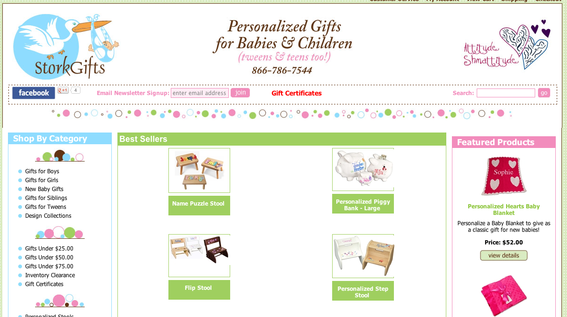
It wasn’t until her youngest daughter attended pre-school that Melissa Perlman Chelist could help manage the small gift website her husband Barry and his business partner David had created two years earlier, in February 2003.
Trained as a special education teacher, Missouri-based Chelist had never worked in the business world. Initially, she had nothing to do with the company she now runs. Barry Chelist, an M.B.A. graduate who worked in telecommunication sales, and his partner, B.S.-educated David, who worked in the luggage business, bought a business in January 2002 named Hollow Woodworks, which manufactured wooden “name puzzle ” stools for children. The pair began to sell the stools online. However, they found it hard to run the factory without being on site. So they sold Hollow Woodworks a year later, keeping the online presence only.
The pair then bought the domain name StorkGifts.com for $25, hiring a young Canadian developer to create a website to sell the personalized stools online, while they kept working full-time.
In February 2005, once her daughter began attending pre-school three mornings a week, Chelist took over customer service, which had been outsourced.
Three years later, Melissa and Barry bought out David, taking over full ownership of StorkGifts. Following her upcoming divorce from Barry this year, Melissa Chelist will be the sole owner of the company.
StorkGifts went from $50,000 in revenue in 2003, to $102,000 in 2004. The revenue at the end of 2011 was $300,000, which Chelist expects to remain steady for 2012.
All of this is done without actually purchasing inventory. StorkGifts operates a drop ship business model, so it has very little inventory.
“Only our personalized books are made in-house,” says Chelist.
Shopping Carts
StorkGifts has used shopping carts LoudCart and Able Commerce. Volusion, a hosted cart, will be its latest shopping cart system.
Chelist said that each subsequent cart automated more processes, providing easier administrator use and better search engine optimization opportunities. Each time something “broke” on one of the websites or they wanted to add another feature, it cost several hundred dollars or couldn’t be done at all.
“Able Commerce offered many challenges. Any time we wanted to tweak the site, we had to pay for it. By contrast, Volusion gives us an up-to-date website which will remain so due to free software releases and enhancements. Ease of use of shopping carts is vital to the success of an ecommerce site. It is far too easy for a customer to leave our website and go to the next one to order the same or similar product.”
Credit Card Payments
Melissa Perlman Chelist
StorkGifts originally captured credit card numbers and expiration dates via its shopping cart but without real-time authorizations, transactions had to be hand-keyed into a credit card terminal in the office.
“In 2004 we hooked up with Authorize.net and a credit card processor to perform real time authorizations, which saved us about an hour every day.”
“We will switch to Clearent, a merchant account provider, which has lower credit card transaction fees than our current 3.5 percent, once our new website goes live. Unfortunately while our costs are lower with point-of-sales transactions, we are an online retailer so we never actually swipe the card, and therefore processing companies charge us higher rates. We also have no cash or check sales, so we incur processing fees on every transaction.”
Order Management
“Originally, we manually entered orders on our vendors’ wholesale websites [to facilitate drop shipping] or we copied and pasted the order information to send the vendor an email order.”
With each subsequent website, StorkGifts has evolved its design and shopping cart.
“Now we automatically email the order information to the vendor or send the order directly into the vendor’s XML order system. This again has saved much valuable time especially as the number of sales has grown.”
Chelist said StorkGifts’ original website allowed customers to enter name letter lengths that didn’t fit within the company’s parameters for a personalized item.
“I would have to contact the customer to clarify the order and either upgrade to a different product and manually charge the additional amount or the customer would cancel the order altogether and I would have to refund their money. Now, nothing that doesn’t fit within our parameters can be added to our cart.”
Hosting
Volusion is a hosted cart. When StorkGifts switches to that platform, its hosting will switch, too. The current cart, Able Commerce, is requires independent hosting.
“We host our website with Tech Evolution, which was recommended by our web developers.
“When their servers go down, our website is inoperable. However, for $25 per month, we get a great deal. They are not available via phone 24/7 but they do have email support after hours, yet it isn’t always timely.”
Employees
StorkGifts outsources those areas in which the Chelists lack specialized skills, including web development, search engine optimization, and graphic design work.
Chelist hopes that with the support at Volusion, she can manage the products, prices, and image updates. If not, she will outsource these tasks. Following the divorce, Barry will no longer be involved in operating tasks. Essentially however, StorkGifts is a family business.
“I do all the daily operations, Barry manages all product, price and image updates and shortly will give Google AdWords management to Today’s Local Search, a marketing firm in St. Louis.
“Our eldest daughter, 16-year-old Andrea, enters the shipping information and helps to make books when she is available. She now also processes orders, reconciles invoices and helps me locate new products.”
The Chelists’ younger daughters, Leah (13) and Sophia (10) help Andrea with the shipping reports, reconciling invoices and processing orders.
Search Engine Optimization
StorkGifts began doing SEO in 2007 with a company in California, which charged $600 per month.
“We are not quite sure what they did as our sales didn’t improve over the course of a year,” says Chelist.
StorkGifts undertook no SEO between 2008 and January 2011 until it hired St. Louis-based company, The Clix Group, which charged $1,500 per month.
Chelist said StorkGifts’ organic results improved during 2011, but not enough to justify the monthly expense. She ended the contract with The Clix Group in January 2012 when she hired Today’s Local Search, which charges $750 per month.
Today’s Local Search will work on the final stages of development for the Volusion website and will be responsible for all SEO and PPC ads moving forward.
“There has been no SEO on our site from mid-February until July 2012 and I have noticed that our organic placement is beginning to drop. SEO is important for web placement.”
Product Sourcing
Name-puzzle stools, from StorkGifts.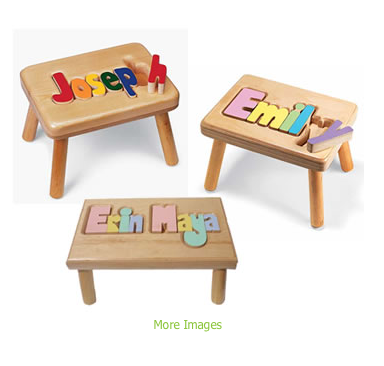
StorkGifts’ products have expanded from a modest range of basic puzzle stools, coat racks, name boards and piggy banks created by two vendors, to about 100 different types of products made by more than 10 artisans throughout the U.S.
Customers can choose the color, design and title of each product.
“We are always seeking new products. As our customers’ children have grown, we have expanded our range from baby products to items suitable for their big brothers and sisters. As our target user is growing, we are increasing our product line to include items for tweens.”
Inventory Management
StorkGifts operate a drop ship business model, so it has very little inventory.
“Only our personalized books are made in-house,” says Chelist.
Accounting Software
StorkGifts has been using QuickBooks since inception.
“Until recently, we manually entered our data, which was a time-consuming experience. It took a while to figure out how to integrate QuickBooks with our cart, but we save so much time now not having to enter each transaction twice.”
Social Media
Chelist said StorkGifts created a Facebook page two years ago and a Twitter handle a year ago. Its email campaign to invite new Facebook Fans was minimally successful.
“Currently, we have 95 Twitter followers and 429 Facebook Fans but our Fans have not increased significantly. We are trying to determine how to convert Fans into actual customers. We would like to have more a more interactive Fan page. I am planning on getting involved in Pinterest.”
Expense Control
As StorkGifts does not manufacture its products, it has limited control over the cost of goods sold.
Chelist said StorkGifts plans to spend what it saves on lower credit card fees on SEO, to decrease its Google pay-per-click advertising cost.
“Finding less expensive ways to market and advertise our products and website is an ongoing and time-consuming battle,” she says.
StorkGifts is also currently challenged by the shipping costs for multiple purchases.
“Our products are made by multiple vendors who ship separately — but each vendor charges us a shipping fee. If a customer orders a personalized wooden puzzle stool, a personalized piggy bank, and a personalized book; they pay one shipping fee, but we pay three of them. For example, our woodcrafter is in Arizona, the artist is based in Delaware, and the books are made in-house, in Missouri.”
Customer Service
Before Chelist entered the business in 2005, StorkGifts outsourced its customer service to a local call center.
“These hourly employees were not familiar with our products, didn’t have a vested interest in serving our customers, and worked limited hours.”
The Chelists’ lack of satisfaction with this encouraged Melissa to make this her first role in StorkGifts.
Biggest Mistakes
“The two biggest mistakes we have made were outsourcing the customer service at $1,000 per month and spending a significant amount of our advertising budget on print ads.
“We purchased a 35-word ad with two photos in a national baby magazine for approximately $2,500 and a full-page color ad in a local family publication. Both yielded no sales.”
Biggest Success
“As expensive as it is Google AdWords has been a huge success for us, we definitely notice that when we reduce our daily budget, the number of new visitors to our site decreases.
“Another huge success is our number of repeat customers. On any given day, we can look at the orders and recognize some of the names. Our customers are extremely satisfied with the quality of our products and the personal attention that they receive.”





 5 Content Marketing Ideas for May 2024
 ChatGPT vs. Gemini for SEO Tasks
 SEO Takeaways from SGE's Partial Rollout
 BNPL Competition Drives Wins for Merchants
 Google Ad Updates Reflect New SERPs
 New Ecommerce Tools: April 2, 2024
 The Profitable Seller: Mastering Amazon FBA