

Search engine optimization, boiled down, is the process of making sure a web page ends up highly ranked on search results, for searches relevant to that page. A merchant selling “Columbia Traverse Men’s Hiking Shoes,” for example, will want to optimize its product page so that searches on Google — or Bing, or Yahoo! — for terms like “men’s hiking shoes” return the merchant’s “Columbia Traverse Men’s Hiking Shoes.”
That process is straightforward when a merchant has just a few products. But what about merchants with thousands of products that are relevant to hundreds of thousands of search terms? How can that merchant devise a system to optimize all of those product pages and match them with the hundreds of thousands of relevant, constantly changing, search terms? Such a system would have to be easy to manage, and scalable across thousands of products and search terms.
SEO Platforms
That’s the purpose of SEO platforms. They attempt to make search engine optimization more scalable, effective and efficient — across thousands of products and hundreds of thousands of search terms. Many measure different SEO metrics — such as raw traffic, conversions, and time on site — and offer recommendations for marketers to improve them. Some platforms actually implement some SEO tactics automatically. But there’s one platform, BloomReach, that debuted this week with a very interesting SEO solution: its “Web Relevance Engine” and “BloomSearch” service.
BloomReach’s head of marketing, Joelle Kaufman, was quick to say that it is not an SEO platform. It’s about “creating the most relevant user experience possible on any page,” she told me. The new platform is focused on improving user experience and conversion by exposing content — such as descriptions on a product page and user reviews — and algorithmically improving its relevance to search terms. Essentially, what BloomReach does is suck hoards of data from a merchant’s site, web analytics, product feeds, social media streams, competitors’ sites and more into its Web Relevance engine by means of an API. BloomReach semantically analyzes the data, determines relevance, decides which pages need additional content and links, and deploys the appropriate content algorithmically to the appropriate pages through its three services: “BloomSearch” for SEO, “BloomLift” for PPC, and “BloomSocial” for social media marketing. The infographic below makes the process a bit simpler to understand.
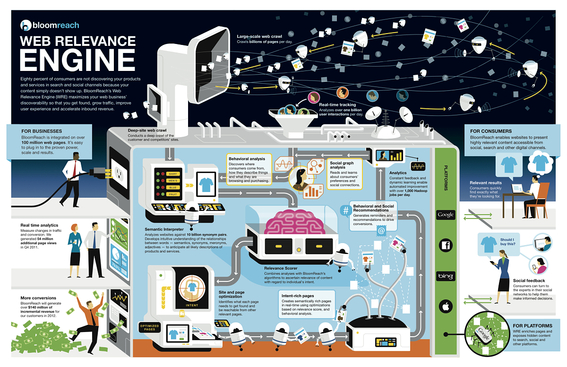
Infographic: BloomReach Web Relevance Engine
That’s smart enough already, but that’s not all. The platform also monitors the optimizations it has made, determines which are successful at driving additional traffic and conversions or how they could be more successful, and alters the optimizations that have been made accordingly. Sounds like SEO nirvana, right? I’m inclined to be optimistic based on what I can see from the outside but until I see it in action on a site I work with and get my hands on the analytics, I can’t say for certain whether it actually is SEO nirvana or not. Here’s what I can say.
BloomSearch as an SEO Technology
First off, it’s the smartest technology I’ve seen yet for SEO. Its goal is to harness “the power of big data, machine learning and large-scale systems science to match relevant products and services to consumers at scale.” Basically, it’s a platform that increases relevance to improve customer experience and usability by exposing the content that customers are looking for. Assuming it does that well, the result for merchant sites would naturally be increased traffic and conversions. And because BloomReach has a pay-for-performance business model, the risk to the client site is essentially nil, apart from the time to set up and implement. In fact, Kaufman did stress that clients began to see incremental traffic and conversions almost immediately.
How is this possible for an SEO platform when it’s well known that rankings take several weeks to adjust and an SEO strategy can take months to mature to full benefit? Well, BloomReach is not an SEO platform precisely. It’s a usability and relevance platform. So on day one regardless of the channel or path customers use to get into the site, they will see the optimized content and it will potentially impact their desire to buy or explore more. The customer may come in via organic search, or paid search, or a bookmark or a link from another site or a prompt from a direct mailing. Whatever that customer’s path into the site, that customer will see those optimizations and potentially be impacted by them. This applies to the search engine crawlers, too, of course.
All About Humans
The most promising part of BloomReach’s technology is that it becomes a part of the site for customers and search engines. It’s not a traditional SEO technology that caters to the search engine’s needs by means of generating content that humans aren’t really meant to focus on. Humans are most definitely meant to see and interact with the BloomSearch content, because it’s focused on improving usability as well as organic search traffic and conversion. That’s a solution that the search engines are sure to like. In fact, Yahoo! is a customer of BloomReach, not to mention the many former Googlers and Yahooligans filling up their staffing rosters.
BloomSearch Widgets
So how does it work? Implementation with BloomReach is fairly direct. Integrate data feeds with their API and place a JavaScript pixel on each page of your site. The potentially harder part is working with your design and development teams to place the BloomSearch widgets on the appropriate templates, to give the dynamically optimized content a place to display. For example, Williams-Sonoma has implemented the widgets on its category pages at the bottom of the product grid. These widgets are from the Grill Pans and Griddles category page
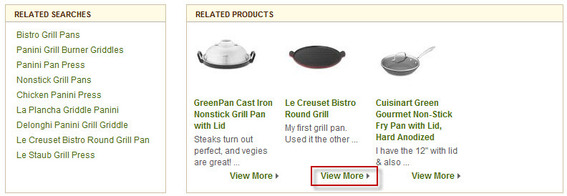
BloomSearch Widgets on Williams-Sonoma
—
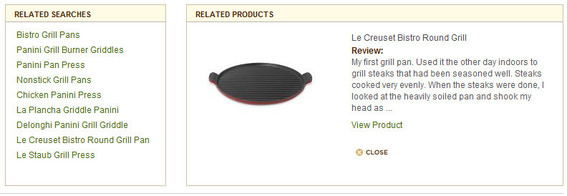
BloomSearch Widget with more review content displayed
The content that BloomSearch places consists of anchor text and links in the “Related Searches” widget, and relevant products with relevant review snippets in the “Related Products” widget. When the “View More” button is clicked, a larger snippet of the review text is displayed using CSS, so that it’s still crawlable on the page for search engines while it boosts relevance for customers, as well. Kaufman was eager to point out that BloomReach doesn’t auto-generate content in the way that SEO marketers think of content. The platform merely identifies the relevant text and links that already exist on the site and cross-promotes them via these crawlable widgets for maximum benefit.
The Williams-Sonoma example is particularly interesting because two of the three product reviews mention “steak,” a food you might reasonably cook with this products on this category page, “Grill Pans and Griddles.” However, none of the text on the category page or in the product descriptions mentions the word “steak.” Web Relevance Engine picked up the relevance between “grill pans” and “steak” from social sources and reviews, and dynamically included it in the widget. That’s very interesting, and very smart. But will it drive search traffic or conversions? Again, I can’t say without taking a peek at Williams-Sonoma’s analytics. But if the analytics show that the pairing is not successful, the platform will simply change the optimization to remove those and try another relevance approach to increase traffic and conversion.
This example occurs on one page. Imaging trying to come up with that test on your own, implementing it, measuring it and determining it success before trying something else on that one page. Now multiply that by the number of category pages and products your site sells. It’s simply not possible to do this kind to analysis and optimization at scale without a dynamic service like BloomSearch.
BloomSearch Thematic Pages
BloomSearch has another ace up its sleeve, called “thematic pages.” If consumers are searching for products that a site does indeed offer, but has no landing page for, BloomSearch dynamically creates a thematic page for that phrase and cross-links it through other related pages’ Related Searches widgets. For example, home décor site Bellacor has five queen-sized cashmere blankets, but no landing page to attract searches like “cashmere blanket queen.” BloomSearch identified the need, created a thematic landing page for Cashmere Blanket Queen, and dynamically cross-linked that page with other related blanket, cashmere and queen-sized bedding pages. This is obviously a very detailed, long-tail search. But since the products on the page range between $325 and $1,025, it doesn’t take many conversions to make this a successful page, especially on a pay for performance model.
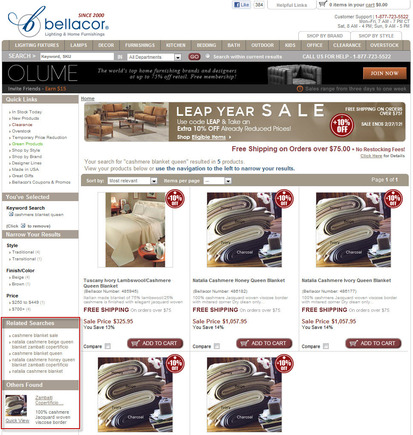
BloomSearch Thematic Page on Bellacor
Note that Bellacor has chosen a different design for its widget implementation, one that makes it feel more like a part of the site’s navigation rather than an add-on. This would likely be a more successful design implementation from a usability standpoint, though from an SEO standpoint there’s no difference.
BloomReach’s Drawbacks
Every solution has its pros and cons. I’m inclined to say that BloomSearch has more pros than cons at this point. But to be fair, let’s look at some downsides. As mentioned, BloomSearch does require design and development time. If an ecommerce site is already stretched thin on those resources it may be difficult to prioritize implementation of BloomSearch. Every SEO platform that I’ve seen has the same issue.
The biggest drawback for any SEO platform, and paid search as well, is that when you cease to pay for the platform, the benefits cease, too. Traditional SEO, conversely, improves the site for the long run. But BloomReach is a temporary solution. The pay-for-performance model certainly helps make the risk small, but it’s important to understand that when the BloomReach contract ends, so will the benefits.
Lastly, BloomReach’s current business model requires a site of at least 1,000 content pages or 1,000 product SKUs to make the economics feasible for the company to assign human resources to monitor their algorithmic optimization. The larger the site and the more data from social media and other sources that can be poured into Web Relevance Engine, the richer the output.
The Bottom Line
I’m excited about BloomSearch’s potential as an SEO technology, to increase a web page’s relevance, usability, traffic and conversion. It’s the first SEO technology I’ve seen that does nothing tricky for the purposes of improved SEO that isn’t really meant for human consumption. With BloomSearch, everything it does is meant for humans to consume first. SEO benefits come second. Before I can wholeheartedly jump on BloomReach’s bandwagon, though, I need to examine a site already using it and see the results in black and white in its web analytics. If your ecommerce site is larger than 1,000 SKUs and your data sources are robust, it may be worth a call to BloomReach to learn more.
I’m looking for follow-up to this story, in fact, with a real site as a case study — like we did here with The Motor Bookstore’s SEO struggles. If you implement BloomSearch and want some publicity, please contact me.





 ChatGPT vs. Gemini for SEO Tasks
 5 Content Marketing Ideas for May 2024
 SEO Takeaways from SGE's Partial Rollout
 BNPL Competition Drives Wins for Merchants
 Google Ad Updates Reflect New SERPs
 How to Track ROI from Content Marketing
 The Profitable Seller: Mastering Amazon FBA