
Modern Fulfillment Requires a Modern 3PL

What’s changed in logistics? It’s easier to list what hasn’t. The global supply chain has weathered pandemic-driven disruptions, heightened consumer expectations, elevated costs, and unsettled trade policies.
The ability to adapt has never been more important for retailers. Partnering with an agile logistics provider is a critical component.
Here’s how ecommerce brands stay ahead of the logistics curve in 2026.
Network Is the Strategy
A fulfillment network becomes the strategy in 2026.
Online retail brands must deliver faster while navigating complex supply chains. We recently surveyed 250 U.S. supply chain leaders on their plans for 2026. Roughly 89% believed shifting to domestic suppliers was essential for long-term brand trust, reflecting the value of proximity in enhancing the customer experience.
Speed and resilience drive success in 2026, making distributed fulfillment a key strategy. Today’s merchants require multiple distribution facilities working together, not just one.
The strategy works only if retailers have control and transparency across the network. A third-party logistics partner must reconfigure operations quickly, provide real-time visibility, and deliver reliable performance across regions.
Beyond Proximity
Yet in 2026, fulfillment location is more than proximity alone. Speed is essential, but so is cost, personnel, and risk exposure. All are necessary to scale in the long term.
Brands should look beyond zone-skipping economics and consider labor availability, wage pressure, and, especially, carrier connectivity, such as parcel density, less-than-load access, drayage, and intermodal or rail access, as applicable.
Moreover, weather patterns, congestion, geopolitical exposure, and tariff volatility factor in.
Peter Davis is a longtime logistics expert and senior vice president of commercial operations at Kase. He stated, “Location strategy has become a granular, multi-variable decision. It demands a 3PL that can flex with the network. If your partner can’t adapt as conditions change, your fulfillment strategy stalls.”
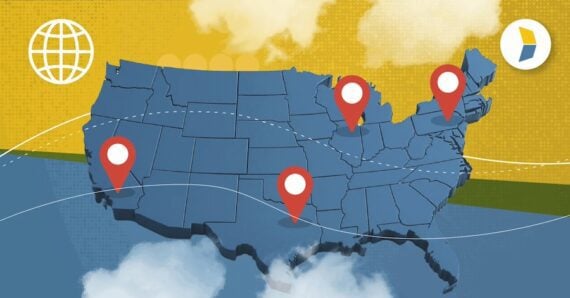
Distributed fulfillment is a key to modern ecommerce logistics, as shown in this example from Kase.
Dynamic Inventory
Thus many retailers are replacing the “one big distribution center model” with interconnected nodes that segment inventory through coordinated systems. Think regional distribution centers, micro-fulfillment locations, overflow or pop-up capacity, and partner sites. It’s a system that intelligently orchestrates inventory: fast movers versus long-tail, direct-to-consumer versus wholesale, seasonal versus evergreen.
Success is no longer measured solely by cost-per-order but by cost-to-serve by region and channel, paired with network-wide consistency.
Modern fulfillment routes orders based on promise dates, landed shipping costs, capacity, and real-time inventory health. The resulting flow gets smarter, and inventory and orders route dynamically.
Leading providers identify, communicate, and resolve hurdles quickly. Inventory accuracy and frequent cycle counting are table stakes.
In short, performance under imperfect conditions defines the strength of fulfillment.
Returns Matter
In 2026, reverse logistics are an extension of the fulfillment network.
The speed of returns impacts resale value and customer loyalty. By expanding returns to multiple locations, brands can reduce transit times and accelerate refunds and exchanges. Disposition must go to the node optimized for restocking, refurbishment, liquidation, or recycling.
Proactive Operators
Modern 3PLs are proactive operators, not reactive warehouses or mere order shippers.
Today’s logistics providers are critical to broader brand strategy while offering continuous daily improvement measured through clear KPIs.
Outdated 3PLs:
- Quote storage rates, but can’t advise on network design
- Treat 2-day shipping as a goal, not an engineered outcome
- Lack standard operating procedures for multi-site operations
- Provide delayed or fragmented visibility
- Offer reactive peak planning with uncertain capacity
- Devalue returns with slow, manual processing
- Resist integrations
Agility in 2026
WSI | Kase’s survey found that 84% of retail leaders expect to restructure 3PL partnerships in 2026. Only 58% feel confident their 3PL can handle strategic shifts.
Demanding consumers and competitive markets compel retailers to reassess their networks, test peak readiness, and scrutinize their fulfillment provider’s roadmap. The result is speed, stability, and customer trust in 2026 and beyond.
About Kase
Kase™, a part of the WSI® family of brands, is the premier provider of direct-to-consumer, retail, and omnichannel order fulfillment services. With strategically located facilities across the U.S. totaling over 14 million square feet, we offer brands and retailers the scale and multichannel supply chain expertise they need to grow. Our proprietary fulfillment technology platform was developed specifically for ecommerce merchants and omnichannel retailers, providing real-time order tracking, order routing, inventory control, and parcel rate selection. Learn more at Kase.com.
About WSI
Founded in 1966, WSI is one of the largest privately held logistics companies in North America. With the perfect mix of people, processes, and technology, WSI empowers brands to make the most of their supply chain operations. We help retailers optimize logistics spend, streamline operations, and improve customer satisfaction via a collaborative partnership.
To learn more at Wsinc.com.
