


An ecommerce merchant might sell the exact product a generative AI shopper wants and still not appear in the platform’s recommendations.
The disconnect starts with how consumers use AI chat and shopping.
For example, a shopper could specify in a single prompt the price range, size, material, compatibility, intended use, delivery date, and more.
The merchant’s job is to make those specs easy to find and verify. The task is traditional search optimization, but elevated. More than ever, today’s product data must answer questions that shoppers once had to uncover themselves.
Here are five tests to see whether AI-driven shoppers can find your product.
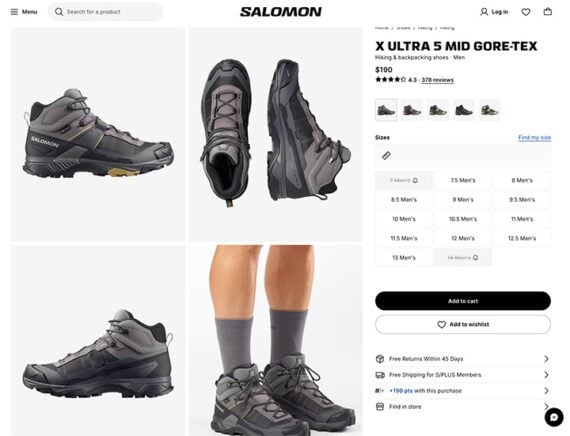
Extensive product data, such as what’s on this Salomon boot page, helps AI appeal to shoppers.
Identify
Can an AI shopping agent or chat understand the item?
A product listing should include a product name, brand, category, SKU, and, when applicable, a GTIN, UPC, EAN, or manufacturer part number. Variants identify size, color, model, or configuration.
This is basic product-data hygiene, but it’s essential for shopping agents or chats to identify matches.
In other words, establish what the product is before asking an AI system to recommend it.
Prove
Does the available product data satisfy all of a shopper’s requirements?
Imagine someone asks AI to “find waterproof hiking boots under $180 for wide feet, suitable for rocky trails, that weigh less than three pounds.”
The request contains at least five constraints:
- waterproof,
- price,
- width,
- terrain,
- weight.
A retailer may sell the perfect boot, but an AI system may not match it if the product page or catalog omits weight or width.
AI platforms both understand the complexity of this problem and see it as a way to attract shoppers. OpenAI touted its shopping system’s ability to discern complex queries in its initial shopping announcement.
Google Merchant Center specifies an attribute called [product_highlight] for important characteristics and common consumer questions. The attribute helps “customers discover information about your products across AI-driven surfaces, like AI Mode in Google Search,” according to Google’s documentation.
A useful exercise for exposing attributes and optimizing product detail pages is to list shoppers’ likely questions and then answer them in the items’ descriptions.
Verify
Can an AI agent or chat verify what the shopper will purchase and receive? A good product match is not enough if the offer itself is wrong.
Ensure that the product page, feed, cart, and checkout agree on price, availability, shipping cost, delivery timing, promotions, and purchase terms.
Google, for example, requires products in Merchant Center to match the landing page and checkout. It also recommends structured data for important offer information.
This matters when shoppers add constraints such as “under $180,” “in stock,” or “arrive by Friday.”
Supply Evidence
Can an AI shopping agent or chat find enough evidence to support a recommendation?
A product detail page should do more than assert benefits. It should give an AI shopping bot facts that explain why a product fits a shopper’s needs.
Salomon’s X Ultra 5 Mid Gore-Tex detail page is a good example. The page identifies the waterproof membrane, outsole, cushioning, fit, weight, construction, and intended terrain. It also includes multiple product images and customer reviews.
That is much more useful than a broad claim such as “built for rough weather.”
OpenAI stated that its Shopping Research feature gathers information from reviews, specifications, images, price, availability, and more, then uses those details to compare products and explain differences and tradeoffs.
The test, then, is whether the product page gives an AI shopping system enough factual support to explain the recommendation rather than repeat the retailer’s pitches.
Shop
What happens when an AI shopper describes a product that you sell?
To test, select a handful of your products and create realistic prompts based on consumer needs, not brand or product names.
A sample prompt from a kitchen supply retailer might ask for a pan under a certain weight that works on induction, can go into a 500-degree oven, and has no synthetic coating.
A computer-accessory retailer might test compatibility, dimensions, power requirements, or operating systems.
Run those queries in ChatGPT, Google, Perplexity, or the AI platform your store’s audience uses.
Record whether your product surfaces, how accurate the results are, and what’s missing.
Shopify attempts this with its Agentic sales channel, which includes a search-preview tool showing how products might rank in Shopify Catalog searches.
The point is not to treat a few prompts as a ranking report. It is to replicate a shopper and look for gaps in the information AI chats or agents have available.
Discovery on AI platforms requires complete, specific, and trustworthy product info, not a bag of new optimization tricks. The goal is to clearly match a shopper’s needs to your product so an AI system will recommend it.





 The Race to Own AI Shopping
 New Ecommerce Tools: September 8, 2026
 Google's Redirects Blur Search Rankings
 Influencers Mostly Skip Disclosure
 New Ecommerce Tools: September 2, 2026
 Branded Sites Are Vital for Merchants