


In the ecommerce business, there are innovators and trendsetters, those companies and individuals who think ahead and produce changes. We’ve asked an expert ecommerce observer to help us identify some of these companies and individuals.
The observer is Harley Finkelstein, chief platform officer with Shopify, the hosted shopping cart. This month’s installment of “Innovators and Trendsetters” focuses on three unique sites and the implications they may have for ecommerce.
Practical Ecommerce: Tell us the three innovative sites that you want to talk about this month.
Harley Finkelstein: The first case study is Manpacks.com. The second one is Empty My Apartment! The third is Threadless.com.
My idea for these sites is to show how ecommerce users have started using the concept of online retail in some very interesting, unique ways, and more importantly, that by using these techniques and this new business model, you’re able to do some really cool things that were unavailable in the traditional brick-and-mortar retail setting.
PEC: Let’s start with Manpacks. What is unique about that business?
Finkelstein: “Manpacks is an automated delivery of underwear, socks, and other essential men’s products. Effectively, this company was built on the idea that men don’t spend much time thinking about their underwear or socks. This is a subscription-based service that allows you to receive recurring deliveries of underwear, socks, and basic white t-shirts, so you effectively don’t ever need to buy these things again.

Manpacks.com sells men’s clothing via subscription.
The idea is that when you go into a traditional brick-and-mortar store, you buy a pair of underwear and a pair of socks; the entire transaction begins and ends in that store. When you leave the store, the transaction is terminated, and if you want to buy additional socks or underwear, you have to go back and buy them again. In contrast, with this methodology, because they’re using an ecommerce platform that allows you to reorder continuously, it’s kind of like having your man essentials on autopilot. I think it’s a very compelling business model.
PEC: That strikes us as a growth area for many ecommerce businesses. Amazon Prime would be the leading example, perhaps, of an innovative ecommerce subscription service. Is this a growth opportunity for other ecommerce businesses, selling subscriptions?
Finkelstein: Absolutely. There are effectively two ways to raise revenue: either you have more customers come to your site to purchase products, or you keep the number of customers constant but increase their ARPU (average revenue per user). The nice part about Manpacks is that these subscription-based retail concepts are only available online. They’re able to increase that ARPU because, rather than selling one pair of underwear, one pair of socks, or one t-shirt, a consumer can effectively purchase six months’ worth and have it delivered every month.
I don’t know the ins and outs of Manpack’s finances, but I can tell you they’re continuously adding new customers and attracting more eyeballs to Manpacks.com. Concurrently, they’re making sure their average revenue per user is rising; it’s a recipe for success. The idea of subscription-based products or automated delivery of certain products is a compelling business proposition.
PEC: Let’s move on to your second example today: Empty My Apartment!
Finkelstein: This is a guy named Brian. He’s been living in Texas. He’s moving to San Francisco, and he initially considered moving all his stuff — including his car, furniture, and television sets — from his apartment in Texas. He realized that obviously moving tends to be fairly expensive. In his case, it was prohibitively expensive. He’d have to drive his car to the West Coast.
So, he began to think of what he could do. The initial idea was that he’d set up a garage sale where he’d just let local people come to his house and buy these things. He was directed to look at things like Craigslist. The problem was that there’s no guarantee people will show up when they make an appointment. It tends to be very time-consuming.
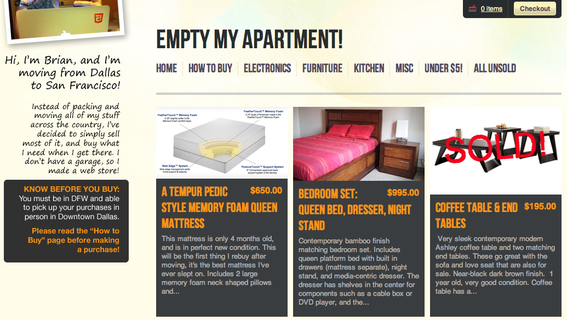
Empty My Apartment! is a limited-time, one-time-use ecommerce site.
So Brian took a different approach. He found that on Craigslist, it’s hard to gauge the quality of different items. He felt he had to really drop his prices to sell. So, rather than listing his stuff on Craigslist, he created a very simple website, Empty My Apartment! He created this very creative solution as a tool to sell all these things. Last time I checked, he had sold about 50 percent of the items on the site.
Most importantly, it took him about an hour to get set up on the site. He did use Shopify — the company I work for. He used a very simple template for the front end of his store. It looks great, very easy, and as soon as he sells off the products, presumably he’ll take the store down and de-list it. [Editor’s Note: Empty My Apartment! has since been taken down. Brian apparently sold all of his items.]
PEC: How does he get visitors to the ecommerce store?
Finkelstein: That’s very interesting. A couple of different ways. He has talked to a couple of different blogs about what he’s doing. That’s produced some decent traffic. The other way is to use Twitter and Facebook; you can like it and tweet out particular products to your friends. That has been very valuable.
When it comes to purchasing used appliances and used couches, there is a bit of a collegiate demographic — people that are college students — and so, as a sort of worst-case scenario, he was going to look to somebody in college and universities and see if he’d be able to sort of sell to that as well. But the traffic hasn’t been a concern for him at all. He put links here and there, and that’s driven some really good visitors to his site.
PEC: The innovation concept with Empty My Apartment! is that he’s able to deploy the store quickly and cheaply and sell products in a manner that he wouldn’t otherwise be able to sell them. Then he can pull it down. So, it’s a very finite use for a store, right?
Finkelstein: In this case, Brian has some understanding of ecommerce. He’s not necessarily a programmer; he didn’t need any programming to do this. But this is really what we mean when we say “democratizing ecommerce”: you can throw up a store in an hour, sell thousands of dollars’ worth of products, including the $25,000 Audi A6 he’s selling there. Then, when the products are done, you can sort of roll up your store and move on. This is just a unique way to do that, and he’s done a great job.
PEC: The third site you’re going to tell us about is Threadless.com, the t-shirt site.
Finkelstein: When Threadless launched, it got a lot of attention. The thing I initially noticed about Threadless was that it had the coolest t-shirt designs. It’s a t-shirt website where anyone can submit a design, and the community at large can vote on it. Depending on how many votes a design gets, once it reaches a threshold, Threadless prints those t-shirts for commercial sale on the site. That in itself is unique.

Threadless.com relies on consumers to submit t-shirt designs and then vote on them.
What I think is really unique about Threadless — something that was never available in the traditional retail model and is only possible in ecommerce — is that, effectively, there is no separation between producer and consumer. The lines are completely blurred. The reason for it is the strong community aspect. If I submitted a design that people really liked, it got voted up, and Threadless produced it, I would actually receive a commission on those sales. But more importantly, through my interaction with Threadless, I also became a loyal consumer and community member.
PEC: So, for those that aren’t familiar, walk us through the mechanics of Threadless. Say I have a t-shirt design that I want to submit.
Finkelstein: You’ll notice when you go to Threadless.com, there is a link that says ‘participate’ and if you go to participate, you have two options. The first option is “submit designs,” and the second is “score designs.” If you select ‘submit designs,’ you can literally upload any design that you’ve created. Once I’ve done that, Threadless will digest it and make sure it’s compliant, then send it out to the community. By clicking the “score designs” link, I can vote for designs I think are the coolest, the most compelling, or the ones I would want to buy. Based on the ratings, Threadless will go ahead and produce those shirts, and the community at large can purchase them.
PEC: Participants who rate or score the shirts don’t have to obligate themselves to buy them, right? They can score them.
Finkelstein: Exactly. That’s why the community is so strong: you’re not necessarily committing to buying the shirt by voting for it. All you’re saying is that, given your personal interest or your personal taste, you like this t-shirt. Again, the more votes the shirt gets from the community, the higher the likelihood is of having those produced.
PEC: Anything else?
Finkelstein: Overall, the Internet is in its infancy. I think ecommerce is still new, and we’re finally starting to scratch the surface of what can be done with the nontraditional ecommerce retail model. None of these opportunities was possible in the traditional brick-and-mortar business model. It’s great that we can do this really cool stuff via ecommerce.




 Retail Media's Opportunity Cost
 New Ecommerce Tools: October 7, 2026
 New Ecommerce Tools: October 14, 2026
 New Ecommerce Tools: October 21, 2026
 Guardrails for Google Ads AI
 Desktop Habits Hide Mobile Friction