


Delivery is the primary barrier to completing an ecommerce sale in Africa. I’ve described the challenges posed by landmark-based addresses and the consumer preference to pay on receipt.
The result is high return rates across Nigeria, Kenya, and other large markets, where a refused package means the merchant pays for logistics twice for zero revenue.
However, the industry is moving from managing these failures to adopting a tech stack to avoid them.
Data-based Delivery
Rather than relying on a driver’s local knowledge, a growing cohort of venture-backed fulfillment companies, such as Gig Logistics, Loop, and Faramove, leverage data to predict the likelihood of a successful delivery before dispatching an order.
Address verification. To solve the landmark address problem, logistics firms are integrating tools such as OkHi’s AI-powered verification. It allows customers to verify their location at checkout via a global positioning system, a GPS. Merchants can flag non-verified addresses as high risk.
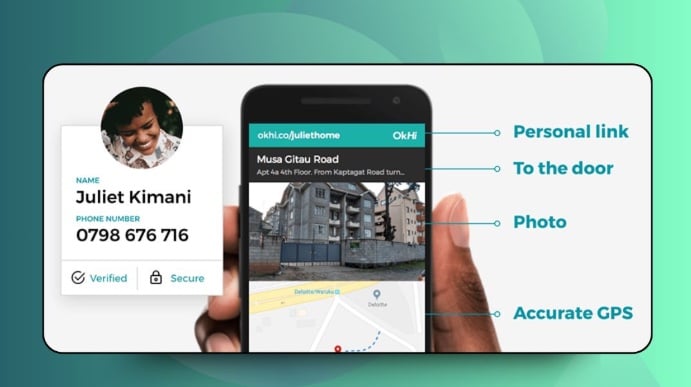
OkHi’s API enables customers to verify their location at checkout. Image: OkHi
Risk scoring. Logistics engines now plug into APIs such as VerifyMe’s QoreID. The tool provides a confidence score based on location data and past delivery behavior. A phone number with a history of refusing orders is high risk.
Automated WhatsApp flows. Flagged orders trigger automated communication to the customers via WhatsApp from APIs on platforms such as Termii (Nigeria) or Talksasa (Kenya). The system automatically redirects orders to a local pickup point for customers who do not respond.
The success of these tactics is evident in Jumia’s financial statements. According to its February 2026 report, the dominant African marketplace lowered its 2025 fulfillment expense per order by 12% year-over-year to $1.97, largely by shifting much of its delivery volume to PUDO (Pick Up, Drop Off) locations. This strategy is anchored by its JForce network of over 40,000 local consultants who act as trusted pickup points, bypassing high-risk doorstep delivery in congested capitals.
Investments in Logistics
In February 2026, funding for logistics and transport startups in Africa ($119.6 million) surpassed fintech ($54.1 million). Logistics infrastructure is becoming a competitive difference maker.
Warehouses in East Africa
On March 11, 2026, Africa Logistics Properties listed the region’s first real estate investment trust on the Nairobi Securities Exchange. The U.K. government committed $24 million to the listing through its MOBILIST program for sustainable development in emerging markets.
According to the Exchange’s CEO Frank Mwiti during the bell-ringing ceremony, “The debut of the dollar-denominated Industrial I-REIT is a historic milestone for our market. We are providing investors with a seamless gateway to Africa’s industrial logistics sector, combining hard currency stability with regional growth potential.”
Automation in North Africa
In January 2026, Egypt-based carrier Bosta launched a large automated sorting center in Cairo, the largest such facility in the Middle East. Capable of processing 11,000 parcels per hour, the center aims to reduce manual errors as Bosta prepares to handle 80 million parcels this year.
“This sorting machine alone required an investment of $5 million,” said Bosta CEO Mohamed Ezzat. “It directly contributes to improving delivery speed and operational accuracy.”
Lockers in Southern Africa
In South Africa, carriers are transitioning the last mile to 24/7 automated lockers. Ship-and-collect provider Pargo leads with over 4,000 points, followed by The Courier Guy’s network of 1,100 lockers as of March 2026. Merchants are seeing a significant reduction in “theft-related” losses and failed doorstep attempts.
Recommended

Payment Friction Wins in Africa
March 3, 2026
Digital Trade
The African Continental Free Trade Area (AfCFTA) is a 2018 agreement among 55 member countries establishing the world’s largest free trade zone. AfCFTA’s Digital Trade Protocol provides rules for data protection and cross-border digital payments. It mandates that African governments recognize electronic trade documents as legally equivalent to paper, enabling merchants to insure and track goods across borders with legal certainty.
A major catalyst for this system is the integration of Kenya’s Pesalink, an instant payment network, with the Pan-African Payment and Settlement System (PAPSS). More than 80 Kenyan financial institutions now sync with 160-plus banks across Africa.
This integration, for example, allows a merchant in Nigeria to settle logistics fees in Naira for a delivery in Kenya instantly, removing a primary barrier to intra-African trade.
Foreign Merchants
For merchants looking to sell goods in Africa:
- Connect to (i) a logistics-as-a-service (Gig Logistics, Loop, Faramove) that offers real-time delivery probability and (ii) an address verification provider (OkHi, QoreID) to flag risk early.
- Incentivize PUDO options at checkout, a successful tactic for Jumia.
- Use PAPSS-integrated channels for cross-border settlement to preserve margins.





 AI Shopping Could Mean Fewer Returns
 Retail Media's Opportunity Cost
 New Ecommerce Tools: October 7, 2026
 Guardrails for Google Ads AI
 New Ecommerce Tools: October 14, 2026
 Desktop Habits Hide Mobile Friction