


Customer service is especially important in today’s socially connected world as consumers can harm the image of a company with a single comment. In my experience advising leading ecommerce companies, the following techniques can help all merchants — large and small — offer excellent online customer service.
1. Emphasize Self-Service
Self-service continues to be an important part of online customer service. Customers have become savvier with using the Internet and they at times prefer self-service to emailing or calling a customer service representative. Also, from a business perspective, it is not cost-effective to have your customers contact your customer service team for every question.
A site should have a frequently asked questions page to address the most common questions. This page should be updated periodically based on new questions. The FAQ page can use rich media, such as how-to videos, to effectively answer customer questions.
A searchable knowledgebase of all customer questions that have been answered in the life of the site is also helpful. It allows customers to search for specific topics if they cannot find the answer on the FAQ page. A knowledgebase can run an automatic search and show the potential answers based on the question the customer is emailing to customer service team.
There are several vendors who offer these features. They include IntelliResponse, Kana, and RightNow.
2. Provide Easy Access to Contact Information
Most larger sites support multiple ways for consumers to contact customer service — e.g., phone, email, chat, and asking customer service to call you by using the click-to-call feature, such as on Amazon. It is helpful to offer these different means of communication but it is also important to have the contact information easily accessible to the customers. Zappos does this well as its customer service phone number is displayed at the top of every page.
Zappos’ clearly-displayed contact information makes it easy for customers to contact them.
Most other sites have a “customer service” or “help” link at the top of every page and after clicking on it, a customer gets access to the contact information for customer service.
Unfortunately, many sites make it difficult to get out of self-service mode and talk to a real person or email someone. They try to answer a customer’s question by using the set of answers available in their knowledgebase or use a virtual customer service agent. I have yet to come across a site where the virtual customer service agent works well. It is a good cost cutting measure but it also leads to disappointed customers.
If you are really serious about customer service, make the contact information easily available. If customers call and there is wait time, tell them how long the wait might be or offer to call them back. Remember, consumers contact customer service because there is a problem. You do not want to aggravate it by offering lousy service.
3. Solicit Feedback
A successful business follows a process of continuous improvement. You can have the best customer service team and tools in place, but it is still important to know what the customers think about your business. This can be accomplished by setting up focused surveys to gather customer feedback. Tools like Foresee and SurveyMonkey can help with creating the surveys, which can be standalone or included as part of existing communication with the customers. For example, including a “feedback” link in order confirmation emails is a good way to gather input, while also making the customer feel valued. Customers can also provide feedback by responding to shorter surveys after your customer service team has resolved their problem. Amazon does this well by sending out a “Yes/No” survey link after resolving a customer issue.
Even a simple feedback form will help you improve your customer experience.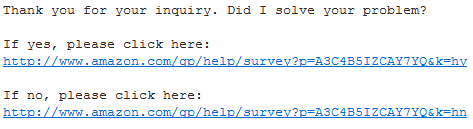
Another way to gather customers’ feedback is to engage with them on social networks. This could be on a public site like Twitter or Facebook or an internal network. As a representative of your company, you will answer customer queries or respond to customer comments on these social networks. Comcast is one example of a company that has been interacting with customers and resolving their problems effectively on Twitter for the last several months. This technique can result in understanding the social perception about your business and handling any negative comments before they become major issues.
Lastly, you could also interact with your customers by conducting periodic customer focus groups to understand how your customers use your site and perceive your business. This is usually is a more expensive option.
4. Foster a Culture of Serving Customers
Customer service requires knowledge of all aspects of your business and a passion for serving customers. This means that the customer service team should be trained before introducing new products or making any policy changes. It is embarrassing for the business to transfer a customer from one representative to the next because the former does not know the answer.
While training is essential, the differentiator is having the culture and the passion to serve customers. There will be instances when customer service personnel do not know the answer or cannot resolve a customer’s problem. But the passion to keep the customer happy will make them think creatively and provide help. If you can make customers feel valued while they are dealing with a problem, you have almost guaranteed their return business. It is not easy to build this culture and requires several factors to be aligned, such as the right environment to work, the right hiring process, focus on customer satisfaction, and critically reviewing the root cause of every negative comment or mistake. This culture needs to extend across the entire business, not just the customer service team.
5. Don’t Ignore Analytics
A customer service team needs to generate reports that track metrics, such as (a) products with excessive returns, (b) customers with most calls and emails, (c) average time taken to resolve a customer’s problem, and (d) representatives with the best rate of problem resolution. These metrics will help the team refine their existing processes and serve the customers better. For example, to provide customers with an accurate wait time when they call, review these metrics periodically. If the wait times are becoming longer, then either add more team members or reduce call volume by improving self-service features. Without analytics, it is difficult to determine a proper investment of time and money.
Also, customer service analytics should provide a comprehensive view of all customer interactions. For example, assume a customer calls with a question. If the representative knows that this person has been a customer for several years, yesterday he browsed three products that are related to his question and he calls customer service very rarely, the representative will be able to better serve the customer. The representative can offer guidance around selecting the best of the three products. The representative knows that he is talking to a returning customer and can offer a loyalty discount. The representative can also share, for example, that the company is going to introduce an upgrade within three weeks and if the customer can wait, that upgrade would be the best value for money. This interaction will make the customer feel appreciated. Making all these pieces come together as part of a single customer dashboard requires integration between different parts of your business and the ability for the customer service representative to quickly process all the information.





 Did Google Just Prevent Rank Tracking?
 Google-Criteo Deal Unlocks Retail Media
 Vibe Coding Is Ecommerce's New Excel
 Ecommerce after De Minimis Tariff Exemption
 Control AI Answers about Your Brand
 Visa’s VAMP Could Cost Banks and Merchants

 SEO for AI, Low Traffic, No Clicks
 Tariff Turmoil: How Ecommerce Brands Can Still Win