


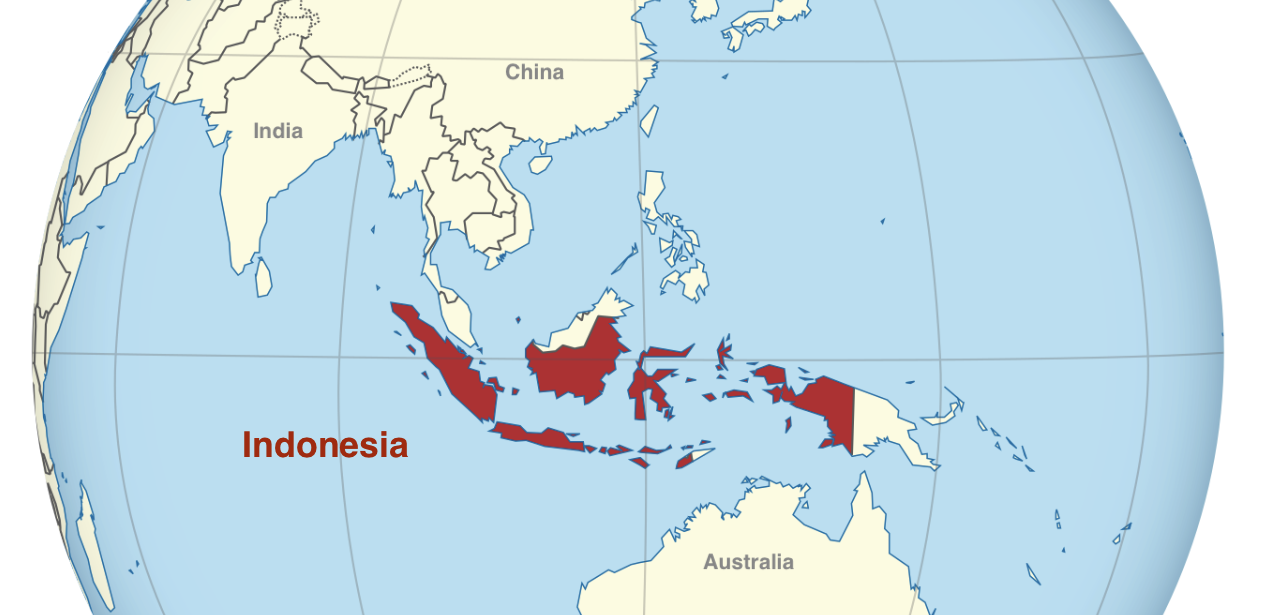
Indonesia has high internet use, low retail sales, and big growth potential. Source: Wikimedia Commons.
The United Nations lists Indonesia as the fourth most populous country in 2026. At 288 million residents, it follows India (1.46 billion), China (1.41 billion), and the United States (345 million).
Comparing retail sales for each country is tricky owing to conflicting sources and composition. A rough equivalent is the World Bank’s annual “Household Final Consumption Expenditure” metric, the “market value of all goods and services purchased by households.”
That metric, last compiled for 2024 data, shows the U.S. at $19.8 trillion, China at $7.48 trillion, India at $2.4 trillion, and Indonesia at $773.6 billion.
Comparable online-only retail sales are equally murky and rely mostly on each country’s government data. An indicator is the number of internet users. DataReportal, an aggregator of global internet statistics, reports China’s 2025 internet users at 1.3 billion (92% penetration), India at 1.0 billion (68%), the United States at 323.9 million (94%), and Indonesia at 230.4 million (80%).
Indonesia’s internet penetration is relatively large, but its retail sales are comparatively small, suggesting the country is poised for online growth.
Marketplaces, Social Commerce
Foreign brands in Indonesia typically start with marketplaces and eventually diversify with local distributors and branded ecommerce sites.
Navigating the market can be challenging, given Indonesia’s geographical and language barriers and, like India, strict rules for foreign companies.
Online consumers shop mostly on local marketplaces, with Shopee Indonesia, Tokopedia, and Lazada capturing 76% of online sales per Asialink, an Australia-based consultancy. Shopee and Lazada also sell first-party retail.
International brands selling via Indonesian marketplaces include L’Oréal Paris, Nivea, Garnier, La Roche-Posay, Maybelline, Adidas, Puma, Samsung, Xiaomi, Philips, Tefal, Nestlé, and Kellogg’s.
Yet social commerce — WhatsApp, Instagram, Facebook, TikTok Shop — is also popular.
Greater Jakarta, with 32 million residents, is the most populous metropolitan area.
Entry Strategy
In Indonesia, foreign brands can sell cross-border, on marketplaces, or through local distributors. All face a strict compliance burden, but a PT PMA is the only structure that gives a foreign brand direct, independent control. The requirements are (i) two shareholders, one of whom is foreign, and (ii) minimum capital of $150,000, among other rules.
A PT PMA provides a business identification number (NIB or Nomor Induk Berusaha), which is required to operate an ecommerce business.
Foreign ecommerce brands in Indonesia commonly adopt an omnichannel strategy with local distributors securing market access, while marketplaces and social channels capture high-volume demand.
A branded website and physical retail build brand equity and secure valuable customer data, albeit with higher compliance and market entry costs. Partnering with local importers can ease customs compliance.
“Distributors” in Indonesia typically purchase sector-specific inventory wholesale and resell it. Example providers include DKSH Indonesia and Enseval.
“Ecommerce enablers,” different from distributors, manage a brand’s official store, marketing, and fulfillment on marketplaces. Jet Commerce and SCI Group are example enablers.
Bahasa Indonesia, the local language, is mandatory by law in ecommerce product descriptions.
A key obligation for foreign brands is a minimum wholesale value of $100 per unit on goods entering the country. Hence low-cost cross-border trade is impractical.




 AI Shopping Could Mean Fewer Returns
 New Ecommerce Tools: September 30, 2026
 Don’t Make Them Count
 Retail Media's Opportunity Cost
 New Ecommerce Tools: October 7, 2026
 New GSC Image Filter Aids Product Discovery