


Consumer brands have long marketed to create demand, earn customer loyalty, and win shelf space.
Whether the setting was a craft fair, a grocery store aisle, or more recently, a search result, the goal was to influence purchase decisions.
In 2026, artificial intelligence may be the next iteration in the battle for customer attention.
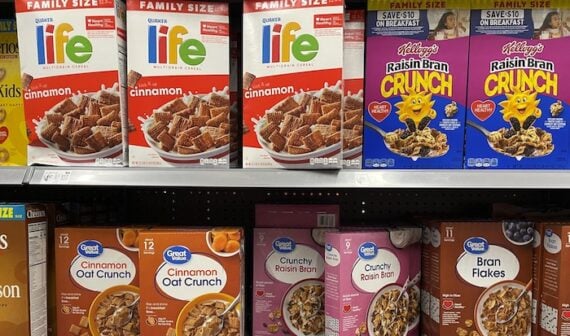
Consumer brand marketing aims to create demand and win shelf space.
AI Shopping
AI-powered shopping tools are becoming a meaningful part of product discovery and evaluation.
A CapitalOne Research fact sheet this month stated, perhaps optimistically, that “almost 60% of consumers have used AI to shop.” Similarly, NielsenIQ reported in early May that 42% of American consumers have used at least one AI tool to shop in the past month.
As AI becomes more involved in shopping journeys, consumer packaged goods companies may need to compete for visibility within the AI conversation.
Anthony Ferry, CEO of Wayvia, a commerce technology company, told Practical Ecommerce that the role of brands is unchanged: to advertise and promote their companies and products to people and retailers. But it now includes “educating LLMs to recommend the brand’s products over competitors’.”
The Store Shelf
The shelf in a physical retail store is a useful analogy for how CPG companies have marketed products for decades.
Brand managers know their products will sit on that shelf next to competing products. Success depends on:
- Getting on the shelf,
- Securing a favorable position,
- Persuading shoppers to choose one product over another.
Yet that challenge has never been limited to consumers. Brands have long worked to influence retailers, category managers, merchandisers, wholesalers, and distributors. Each played a role in determining whether a product reached shoppers.
The shelf itself was the final stage.
Long before a shopper entered a store, brands advertised on television, in magazines, at events, with coupons, and more. The objective was to build familiarity and preference first.
The internet has expanded the number of places where brands compete for attention. Marketing and promotions must now address social media, algorithms, marketplaces, and every other experience across the entire digital shelf.
Winning depends on how well brands can identify these channels and market to or through them.
The concept applies to AI-powered shopping, according to Ferry.
Shoppers may ask AI systems to compare products, summarize reviews, explain differences, and recommend options, and brand marketers must educate and influence those systems.
Hence an AI shopping conversation is another form of shelf space, a place where brands compete for visibility and consideration.
Stacking the Shelf
To brands, this might seem reassuring; the job is the same despite differing venues.
But success is challenging. Ferry stressed the impact on marketing spend.
At one time, television, radio, and print media dominated consumer brands’ advertising budgets. “Then the internet came out. It’s like, ‘I’ve got an online channel now, I’ve got to allocate some of my ad budget pie,'” said Ferry.
Yet online itself is fragmented with search, social, marketplaces, and now generative AI. “Now there are 30 channels,” Ferry stated. Each new channel requires a decision to invest, or not.
Nonetheless, marketers at large CPG companies will seek the most effective channels of the moment. They aim to stack the shelf, so to speak, in their favor with the digital equivalent of better placement, featured displays, retailer promotions, and other levers to increase visibility and sales.





 AI Shopping Could Mean Fewer Returns
 Retail Media's Opportunity Cost
 New Ecommerce Tools: October 7, 2026
 Guardrails for Google Ads AI
 New Ecommerce Tools: October 14, 2026
 Desktop Habits Hide Mobile Friction