

Shoppers who don’t know what they want are an opportunity for marketers to showcase a product.
The word “intent” has always been part of the marketing vocabulary. Examples are “purchase intent” and “informational intent.”
Each describes targeting prospects based on an apparent need.
AI Opportunity
AI’s growth in search and shopping adds precision to “intent” behaviors and opportunities.
Imagine how someone would look for a coffee grinder in a traditional search versus in a chat with Claude, Gemini, or ChatGPT.
The differences are in query length and complexity. Conventional searches average about four words, while ChatGPT queries, for example, are typically 23, according to a 2026 Semrush post.
Thus an apartment dweller who wants a compact, simple coffee grinder might ask a search engine for just that: a “small simple coffee grinder.”
The same query in AI could have more context: “a quiet coffee grinder for a small apartment that works for pour-over and does not make a mess.”
The best answer to both queries might be a conical burr grinder. The second form, however, exposes the opportunity.
Product Intent Clusters
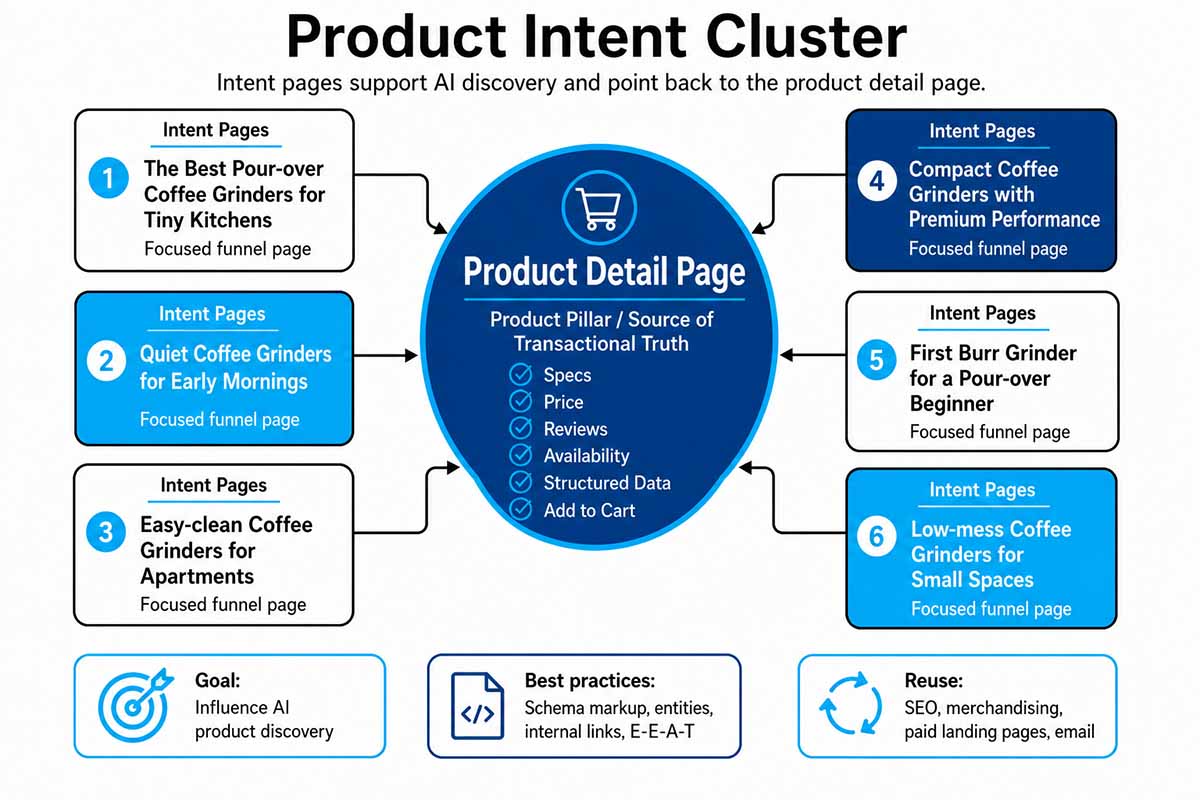
Product intent clusters have a familiar hub-and-spoke structure. Each cluster targets a specific shopper scenario. Click image to enlarge.
As the AI processes the longer, more detailed input, it will presumably search for articles on coffee grinder performance and features.
Ecommerce marketers could combine content, merchandising, and product detail pages to influence AI responses, much like long-tail posts helped optimize organic search listings.
Such product intent clusters resemble traditional topic clusters but focus on information, use cases, and specific customer scenarios that collectively point to a single product, with its detail page at the center.
The product detail page remains the source of truth for a purchase decision: specifications, pricing, and details. The page drives conversions and is rankable, extractable, and understandable as an entity.
Product intent clusters include these elements and more:
- Shows the product,
- Explains features,
- Lists specifications,
- Displays reviews,
- Communicates availability,
- Supports structured data,
- Moves the shopper toward checkout,
- Becomes the center for supporting pages.
This does not mean marketers should turn every product page into a massive buying guide. The page should remain focused. But it can link to supporting content, organize related questions, and clarify the product’s use cases.
Shopping Scenarios
The supporting pages in a product intent cluster are funnel-focused around a specific shopping scenario.
For example, “best coffee grinders for pour-over” is too broad. A better intent page addresses a consumer’s situation: “best pour-over coffee grinders for tiny kitchens.” The shopper wants pour-over quality, has limited counter space, seeks little noise, and wants easy cleanup.
An intent page should guide the shopper toward a purchase:
- Explain the scenario,
- Identify the product features that matter,
- Show why the product fits the need.
Hence the page should also follow traditional search engine optimization, with Schema.org structured data markup and the use of entities.
The page should be useful and readable for humans, but its purpose is to communicate with AI bots.
Aim for dozens (or more) of these intent pages per product.

AI Unlock
Before generative AI, few ecommerce marketing teams could justify researching, outlining, writing, optimizing, and maintaining a page for “the best pour-over coffee grinders for tiny kitchens.”
The use case was too narrow, the labor cost too high, and the potential benefit too uncertain.
No more. Automation and genAI can produce and maintain an endless number of quality intent pages, carefully and precisely prompt-engineered.
The process can even identify the topics. Feed structured customer feedback, such as support tickets and product reviews, into a genAI platform for the intent page topics.
In short, shoppers will likely prompt genAI when they don’t know what they want. Intent pages give those systems a reason to connect a product with a shopper’s need and willingness to buy.




 Retail Media's Opportunity Cost
 New Ecommerce Tools: October 7, 2026
 New Ecommerce Tools: October 14, 2026
 New Ecommerce Tools: October 21, 2026
 Guardrails for Google Ads AI
 Desktop Habits Hide Mobile Friction