


Conversion is the primary job of ecommerce product pages. Ranking in search engines has always been a close second. Until now.
It’s near cliché in 2026 to note that search and product discovery are changing. AI Overviews, AI Mode, various answer solutions, AI chat interfaces, and emerging shopping agents are remaking how consumers find and buy, from luxury items to everyday goods.
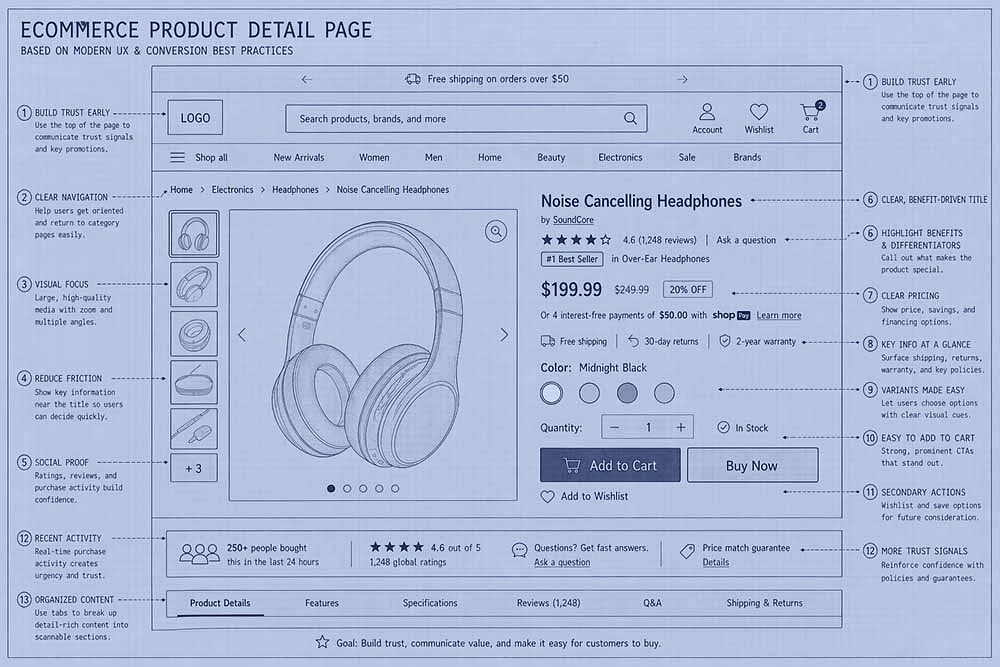
Conversion is the primary aim of a product detail page. But it should also attract traffic via traditional rankings and generative AI visibility. Click image to enlarge.
Information Source
In this new environment, product detail pages must be “AI consumable” to provide answers and model products as structured entities.
Thus today’s product detail pages should be:
- Rankable,
- Extractable,
- Understandable as an entity.
Each aligns with familiar practices. Search engine optimization supports ranking. Answer engine optimization supports extraction. Generative engine optimization supports how AI systems understand and use data.
And a single product page must address all three.
Content Focus
In preparing this article, I used AI to review product detail pages from Amazon, Walmart, Target, L.L.Bean, a collection of direct-to-consumer brands, and several smaller ecommerce sites. The focus was on how the content of these pages addresses ranking, extracting, and understanding — not structured data markup, but content alone.
The AI provided a subjective score for each category of retailer.
| Segment | Example Sources | Rankable | Extractable | Understandable as Entity |
|---|---|---|---|---|
| Marketplaces | Amazon | Very High | Medium | Very High |
| Large Retailers | Walmart, Target | High | Medium–High | High |
| Specialty Retail | L.L.Bean | Medium | High | Medium–High |
| D2C (Structured) | AG1, Beekman 1802 | Low–Medium | High | Medium |
| D2C (Hybrid) | Casper, Allbirds | Medium | Medium | Medium |
| D2C (Aesthetic) | Vuori, Glossier | Low | Low | Low–Medium |
| Small Merchants | Mixed Shopify stores | Low | Low–Medium | Low–Medium |
Rankable
Traditional search still drives visibility.
Almost without exception, the product detail pages passed a basic search-optimization content audit. But large retailers did better, unsurprisingly.
Marketplaces and enterprise retailers such as Amazon, Walmart, and Target tend to use expansive titles, dense attributes, and strong internal links. The pages match many queries, not just one.
Amazon’s product pages include:
- Titles,
- Bullet points (“About this item”),
- Product descriptions,
- Specifications,
- Frequently asked questions,
- Reviews (often thousands of words).
In some cases, the composite product information reaches 10,000 words (mostly shopper reviews), although the average is around 2,000.
Several D2C brands favor clean names and brand-consistent language. The approach improves readability, but likely limits organic reach.
Smaller merchants’ product pages resemble those of D2C brands and could benefit from mimicking Amazon by adding more information.
Extractable
Answers determine what gets used.
To be “extractable,” a product page needs to explain itself directly. What is the product? What does it do? Who is it for? The answers to those questions should be concise and easy to isolate. Discreet sections, labeled features, and question-and-answer formats help.
Many of the product pages reviewed underperform in this area. The exception was the large retail marketplaces, which often contain extensive answer information.
Here again, even small retailers could benefit from adding an FAQ section.
Understandable
Data determines visibility.
Search engines and AI systems increasingly treat products as entities or objects with attributes such as brand, category, price, specifications, and relationships to other products.
While a product entity is certainly communicated through structured data, content also plays a role.
To be understandable as an entity, a product page’s content should define attributes (name, variants, specifications) clearly and consistently.
Product pages from large retailers, especially marketplaces, consistently describe products with clear attributes, normalized naming, and consistent variant handling. This allows products to appear in shopping results, comparison features, and structured listings.
3 Layers Combined
Combined, the three layers should drive traffic from traditional search and generative AI channels.
- A rankable page is discoverable.
- Extractable content facilitates answers.
- Easily understood products can appear consistently across multiple systems.
My AI-driven site review identified patterns related to these layers and their individual goals. But it also revealed a gap.
Marketplaces excel at providing product information. The difference is pronounced and should lead all merchants, large and small, to ensure their product content addresses SEO, AEO, and GEO.
In 2026, you need all three.





 Retail Media's Opportunity Cost
 New Ecommerce Tools: October 7, 2026
 New Ecommerce Tools: October 14, 2026
 New Ecommerce Tools: October 21, 2026
 Guardrails for Google Ads AI
 Desktop Habits Hide Mobile Friction