

In anticipation of its Marketing Live event on May 20, Google announced three forthcoming ad updates: AI Max for Shopping campaigns, AI Brief, and text disclaimers for Search.
All three use AI (with guardrails) for advertisers.
AI Max for Shopping
It was inevitable that AI Max would come to Shopping after its release in Search last year. AI Max for Search gives Google more control over which queries prompt ads and what those ads include.
For example, say an advertiser bids on the keyword “clear storage bins.” With AI Max enabled, Google can show the ad for a query of “What are the differences between clear and plastic storage bins?” Further, Google can alter the ad text and the final URL to improve conversions.
AI Max for Shopping will act similarly, with a key difference: Text ads can show from Google-generated copy based on Merchant Center data. Searchers won’t necessarily see image-based product listing ads, even though it’s a Shopping campaign. Advertisers who opt in to AI Max for Shopping allow ads to show in AI Overviews and AI Mode, as is the case for AI Max for Search.
Google has not revealed whether AI Max advertisers can opt out of text customization and final URL expansion for Shopping, like they can for Search.
The differences between AI Max and Performance Max campaigns can be confusing. Google recommends Performance Max for multichannel promotion across Search, Shopping, Display, and Video. Google will presumably add text customization to Shopping ads in Performance Max campaigns.
For single-channel ads such as Search or Shopping, Google suggests AI Max campaigns.
AI Brief
AI Brief informs Google of advertisers’ preferences. The feature will roll out in AI Max for Search and then to Performance Max and AI Max for Shopping.
In an AI Brief, an advertiser of high-end office chairs might provide:
- “Include pricing in ads to better pre-qualify users before they click.”
- “Do not show ads for queries that include ‘inexpensive’ or ‘low-price.'”
- Prioritize queries that include ‘high-end.'”
In my experience, such guidelines can improve performance but can also limit the algorithm from working as intended.
AI Brief will include a “Text guideline” that will likely resemble that of AI Max campaigns.
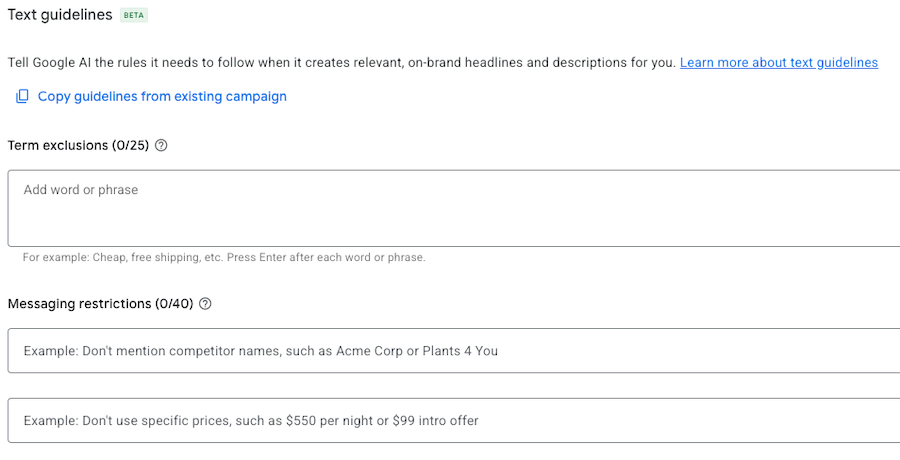
The Text guideline interface in AI Brief will likely resemble the version in AI Max, shown here. Click image to enlarge.
Text disclaimers
Text disclaimers for Search show advertisers’ terms, conditions, and disclosures. For example, an advertiser may insert a disclaimer of “Product is BPA-Free. Learn More.” That text will show in the description line of Responsive Search Ads without pinning.
Moreover, text disclaimers do not affect ad strength scores, unlike pinning. Ad strength is a vanity metric, yet ads with higher scores tend to show more.
Text disclaimers apply to individual campaigns and reside in the “Assets” section of the “Campaigns” tab. The disclaimers appear in the first eligible description space and cannot exceed 90 characters. Finally, they can accompany a final URL expansion and customized text.



 AI Shopping Could Mean Fewer Returns
 New Ecommerce Tools: September 30, 2026
 Don’t Make Them Count
 Retail Media's Opportunity Cost
 New Ecommerce Tools: October 7, 2026
 New GSC Image Filter Aids Product Discovery