


The “direct” traffic channel in analytics software might be mislabeled, misleading, and even detrimental.
Imagine an ecommerce sortation center. When it cannot identify the package’s origin, the center may sort it into a hypothetical “direct” bin. Similarly, Google Analytics and others sometimes assign traffic as “direct” when they cannot attribute it to a specific source.
In analytics-speak, “referrers” and “parameters” are mechanisms for determining where a site visit originated.
- Referrer is the URL of the site a visitor came from. The referrer is passed automatically in most cases.
- A parameter attaches to the end of a URL to share tracking information, e.g., utm_source=email.
Analytics platforms label visitors who come to a site without a referrer or parameter as “direct.”
Thus “direct” becomes a catch-all, potentially co-mingling marketing-driven visits, actual direct inbounds, and even folks coming from Google Discover with traffic that lost its identifying parameters or referrers.
Direct Traffic
Google Analytics typically assigns 20% to 60% of site traffic to “direct,” according to multiple industry reports.
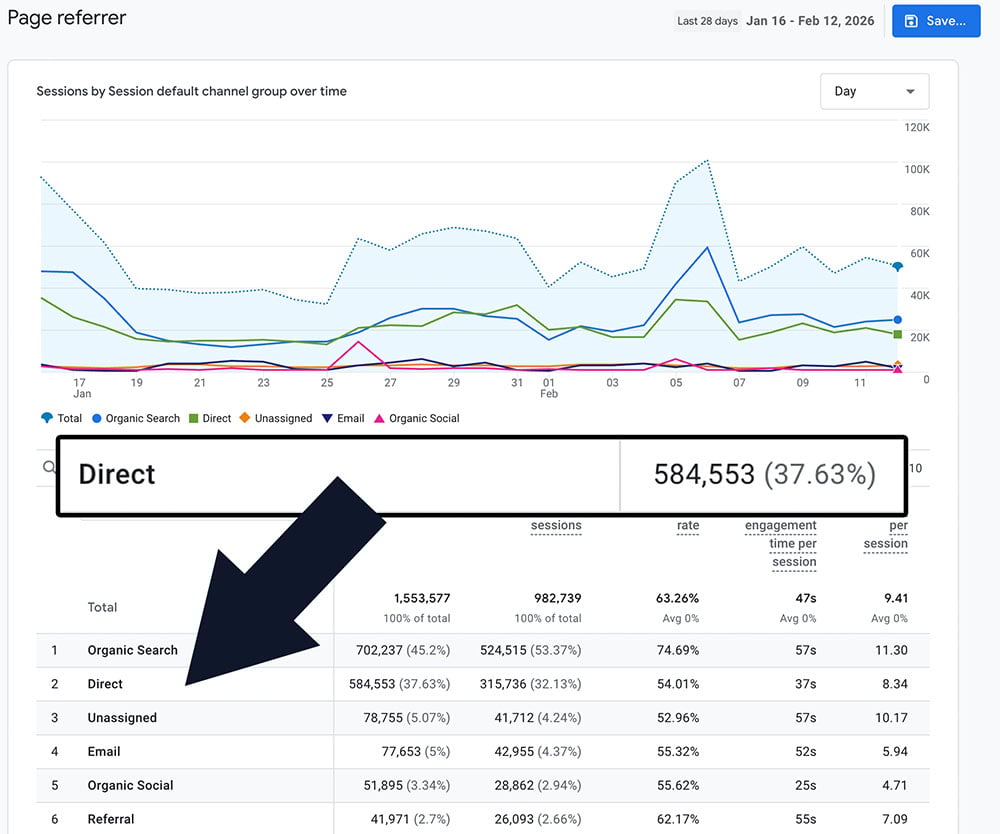
“Direct” traffic accounts for 20% to 60% of a site’s visits, typically.
Yet there’s anecdotal concern among prominent practitioners — including Neil Patel, Jon Henshaw, and Katie Rigby — that direct traffic reported by Google Analytics and others is mislabeled.
The challenge is how marketers think about “direct” visits. A direct visitor was once someone who typed in the site’s URL in her browser. It indicated brand strength and recognition.
But the catch-all nature of today’s direct site traffic reporting can be problematic if it masks marketing effectiveness. An outreach campaign on Discord or a successful SMS campaign, for example, could get lost.
How to Check
To be sure, not all “direct” visits in Google Analytics or similar are mislabeled. To check, marketers can:
- Compare trends. Review “direct” traffic alongside other channels. If “direct” spikes while “organic search” or “social” drops, it’s worth investigating.
- Inspect landing page patterns. Genuine direct visitors usually land on the home page. “Direct” visitors who land on product or other interior pages could be misclassified.
- Audit tagging. Ensure all email, social, and ad campaigns use correct UTM parameters. A missing parameter may cause the analytics platform to misclassify the visit.
If your site’s direct traffic looks suspicious, consider the dead, dark, and blind.
Dead traffic
While it is likely the smallest percentage of “direct” site traffic, “dead” or zombie visits are non-human crawlers — AI agents, search engine tools, monitoring systems, or competitor price scrapers — undetected by analytics providers.
Fast Company explored how bot traffic can distort behavioral signals and muck up marketing. Citing a new vibe-coded social network called Moltbook solely for AI agents, Fast Company stated, “Moltbook is a harbinger — the first real sign that a new type of internet is upon us….a ‘zombie internet’ that could have devastating consequences for advertising.”

Moltbook is a vibe-coded social network for AI agents.
Dark traffic
“Dark” traffic refers to legitimate visits without clear referral or parameter data. Examples include:
- Dark social. Many social media applications and platforms, such as WhatsApp and Slack, do not allow referrers or parameters.
- Dark AI. Some AI platforms share links but do not pass referrer data when clicked.
- Clean URLs. Some browsers and email clients, such as the Brave browser and Apple Mail, remove tracking parameters.
- Privacy and ad-blocking software. Browser extensions can also remove parameters from links and suppress referrers.
Analytics blindness
A sortation center tracks all arriving packages but routes those without an originating address into the “direct” bin.
In contrast, “blindness” results from visits that never reach analytics software, most often due to extreme privacy protection applications. Rather than just removing parameters, some apps block JavaScript from loading altogether, preventing Google Analytics and other platforms from recording the session.
Attribution Gaps
Mislabeled “direct” traffic obscures the truth. Merchants engaged in community marketing and advertising, or who attract privacy-minded shoppers, should audit their “direct” visits to avoid cutting high-performing channels.
Moreover, analytics software is not the only way to measure. Alternatives include:
- Zero-party data. Use post-purchase surveys asking, “How did you hear about us?”
- Trackable codes or pages. Use specific coupon codes or landing pages for distinct channels.
- Media mix modeling. Use statistical analysis rather than user-level tracking to correlate spend with revenue.
- Identity resolution. Retention.com, Audience Bridge, and similar services can help identify anonymous traffic and match it to conversions.




 New Ecommerce Tools: September 16, 2026
 New Ecommerce Tools: September 23, 2026
 Test Your Products for AI Discovery
 Branded Sites Are Vital for Merchants
 Shopify Opens to Meta Muse; Amazon Balks
 AI Shopping Could Mean Fewer Returns