


Many ecommerce businesses are adopting an AI and automation culture that encourages experimentation and problem-solving.
The effect is a renaissance of do-it-yourself projects reminiscent of the ecommerce industry’s early innovations. It is a test-and-see attitude.
AI Trend

LinkedIn’s 2025 “Work Change Report” foretells a more innovative, AI-driven workplace.
Myriad surveys and reports point to the emerging DIY shift.
A 2025 LinkedIn study found that 80% of C-suite executives believe AI adoption is important and will foster a more innovative workplace culture. Gartner reported in December 2025 that 65% of employees said they are excited to use AI at work.
The trend suggests a convergence of three priorities.
- Management fears their companies will fall behind if they don’t adopt AI and automation.
- Employees use AI because it makes their jobs easier, and the knowledge gained is an important career skill.
- The cost of off-the-shelf software and development makes AI an attractive alternative.
Old Is New Again
Here is an example. I interacted with a business in the northwest U.S. that gave nearly every employee access to premium accounts with OpenAI, Gemini, and the workflow automation platform n8n.
Management encouraged employees to tackle problems with AI. I reviewed examples and found the staff had built a simple n8n-driven tool to monitor competitors’ prices.
It was relatively basic. It gathered prices, used an AI agent to compare them against its own data, and added them to a Google Sheet each week. That weekly update fed a pivot table that the marketer used to identify changes.
It was similar to my 2015 article, “Monitor Competitor Prices with Python and Scrapy,” which described a simplified price-checker from a regional retailer that was less expensive and less functional, yet still a functional problem-solver.
DIY
A boiled-down version of the n8n price checker does not even require AI, and might have just four steps.
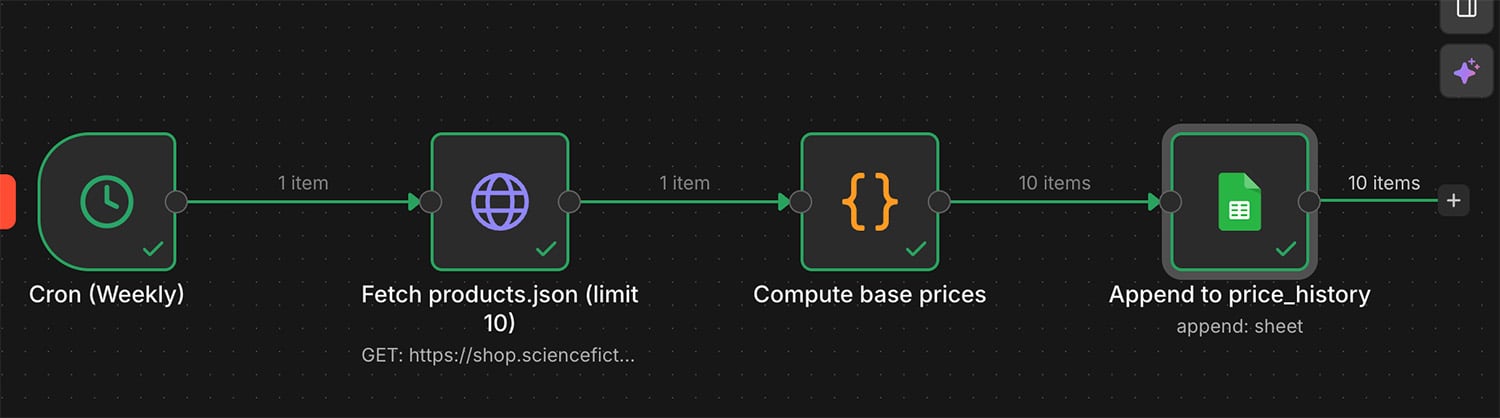
The n8n workflow fetches prices weekly and appends the results to a Google Sheet.
Here is how it would work.
- Use an n8n cron node ( a scheduler) to run the automation once per week.
- An HTTP Get request node fetches competitors’ products and prices. In some cases, collecting the data could be as simple as adding /products.json to a shop’s URL.
- A code step uses JavaScript to find the lowest price in a set of product variants.
- A Google Sheets integration captures the data.
Merchants may not even need to assemble the workflow manually. Generative AI tools can produce n8n-importable JSON files from simple prompts.
Culture
The importance of the price-monitoring example lies not in the workflow but in the attitude it fosters. A member of the marketing team with almost no programming background built a problem-solving automation.
Ultimately, a developer might improve the workflow or clean up the code. Nonetheless, the shift toward building something reduces the friction between operational problems and solutions.
The DIY attitude that drove ecommerce entrepreneurs years ago is reborn with this new set of tools.
With an AI and automation-first culture, a team could build custom workflows, such as:
- Inventory monitoring. An AI agent watches stock levels and sales velocity. The tool warns when inventory is low and suggests promotions when it is high.
- Review sentiment extraction. AI analyzes each new product review, deducing its sentiment and theme. Insights feed support prioritization or marketing content without manual sorting.
- FAQ chatbot. Using n8n, a frequently-asked-questions database, and ChatGPT, a merchant builds a custom chatbot to answer shoppers’ questions.
- Customer-service email filter. Connected to Gmail, Slack, and a customer-service ticketing system, an AI agent monitors the customer-service inbox, sorting messages into tickets or sending Slack messages in an emergency.
- 3D video generation. This workflow uses Google Drive, Remove.bg, and Fal.ai to convert product videos for a Shopify store.
Opportunity
The DIY trend is an opportunity wherein AI and workflow needs converge. Executives seek competitive protection, employees pursue efficiency and skills, and budget constraints limit software and development.




 AI Shopping Could Mean Fewer Returns
 New Ecommerce Tools: September 23, 2026
 Test Your Products for AI Discovery
 Shopify Opens to Meta Muse; Amazon Balks
 New Ecommerce Tools: September 30, 2026
 Don’t Make Them Count