


The rules for online product returns differ significantly in the E.U. and the U.S.
Distance buying in the European Union includes a statutory right of withdrawal. Consumers can cancel an online purchase within 14 days of delivery without giving a reason, subject to exceptions such as personalized goods and perishables. The rule applies across member states and forms part of the legal structure of ecommerce transactions.
In the United States, retailers set their own return policies. There is no federal law. Policies vary widely across merchants and categories, shaped by competition and customer expectations.
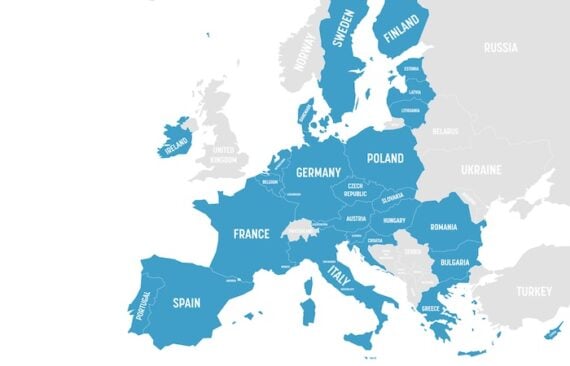
The E.U. rules for online product returns are mainly statutory.
Returns Volume
The National Retail Federation estimated in October 2025 that buyers will return 19.3% of U.S. online sales during that year.
Statista reports that E.U. customers returned around 7% of overall ecommerce revenue in 2024, with sharp variation by country. Germany leads, with 55% of online buyers returning at least one product.
The legally mandated withdrawal right in a high-return category creates a predictable but significant cost layer in the E.U. In the U.S., merchants can theoretically limit exposure.
Under the Consumer Rights Directive, E.U. merchants must issue refunds within 14 days of receiving a consumer’s withdrawal notification. However merchants may withhold the refund until they have received the returned items or the consumer provides proof of dispatch. Merchants must process refunds using the original payment method.
The 14-day deadline pressures cash flow for businesses with high return volumes.
In the U.S., retailers determine refund timing. Most process refunds within several business days, but again, there is no statutory requirement. Payment networks settle disputes, but they too impose no universal timeframe.
Hence U.S. merchants can align refunds with operational realities and customer expectations.
Shipping Costs
E.U. consumers are typically responsible for return shipping if it’s clearly disclosed before purchase, although merchants must reimburse the original delivery cost.
Merchants in the E.U. can reduce refunds for products with diminished value through use.
In the U.S., merchants have more flexibility. They can pay return shipping to remain competitive, or not. They can impose restocking fees and deductions, or not. Amazon, notably, offers free return shipping with no additional cost to buyers.
Despite this flexibility, competitive dynamics frequently lead to similar outcomes in the two regions, though the legal frameworks remain distinct.
Return-related losses are driven less by policy and more by execution. In the E.U., failure to clearly disclose return conditions can shift cost responsibility back to the merchant.
In the U.S., generous policies can increase return rates, especially in categories where customers order multiple variations with the intention of returning part of the order.
Across both regions, reverse logistics costs extend beyond shipping. Inspection, repackaging, restocking, and potential markdowns all contribute to the total cost.

Expansion Planning
Thus merchants selling in both regions need separate return strategies. A single global policy creates either compliance risk in the E.U. or unnecessary costs in the U.S.
In the E.U., the priority is disclosure: clearly communicate the withdrawal right, return shipping responsibilities, and refund timelines before checkout. Maintain current documentation and refund workflows within the 14-day statutory window.
In the U.S., the priority is optimization: benchmark return policies against category averages, track return generosity versus conversion rates, and model return costs into pricing.
Regardless, merchants who model return costs into expansion planning strengthen their positioning versus those who treat it as an afterthought.





 AI Shopping Could Mean Fewer Returns
 New Ecommerce Tools: September 30, 2026
 Don’t Make Them Count
 Retail Media's Opportunity Cost
 New Ecommerce Tools: October 7, 2026
 New GSC Image Filter Aids Product Discovery