


AI-generated marketing content is effective only when it attracts organic traffic from search engines, LLMs, and Google Discover.
Content marketing exists to attract, engage, and retain customers. For ecommerce marketers, attraction is often the primary role.
Historically, that meant search. Articles ranked, generated visits, and fed the top of the funnel. Plain and simple.
Retention matters too, but content marketing works best when it acquires prospects.
AI Gives and Takes
The advent of ubiquitous AI is a double-edged sword for content marketers.
On the one hand, AI makes producing content cheap, at least in a utilitarian sense. But AI has also flooded the internet with relatively low-value content and changed the way consumers search.
Moreover, in 2026:
- AI has increased the percentage of zero-click search results.
- Many customers begin and end searches with AI chat.
- AI-generated articles increase competition for organic traffic.
- Feeds such as Google Discover and Perplexity Discover are traffic generators.
Consider Google’s February 2026 algorithm update, which focused on Google Discover. According to DiscoverSnoop, a Google Discover-focused research firm, several large websites lost significant Discover exposure after the rollout.
- “The biggest loser appears to be Yahoo, which lost nearly 50% of its content, with its audience plunging by 62%.”
- “Go.com, which was redirecting to ABCNews.com, totally disappeared from the ranking, dropping to zero, and ABCNews.com was not able to replace it.”
- “Among mainstream publishers, the Fox franchises (News, Business, Weather) experienced a visibility drop of more than 40%.”
Algorithm updates, zero-click search results, and changes in consumer behavior create a vicious cycle of AI-generated content.
It works something like this.
As organic traffic declines across search, LLMs, and feeds, the relative cost of content rises. To offset that cost, marketers turn to AI. But more AI-generated content increases competition, worsening performance.
Competing articles from the same AI models and prompts are similar in tone and substance. It’s “AI slop” applied to content marketing.
Quality Is the Solution
A year ago, AI offered a speed or cost advantage. That advantage has largely disappeared.
The differentiator now is execution. Marketers must produce AI-assisted content that is structured, validated, and refined. In practical terms, that means improving quality.
Marketers first need to overcome a bias. We must assume AI-generated content can be at least as good as that of humans. To this end, consider a recent quiz from The New York Times comparing human-written text to an AI-generated rewrite. Thus far, roughly half of Times’ readers preferred the AI-generated versions.
Second, we need to believe that AI-assisted content can be optimized and systematized.
12-Step Framework
The way to improve AI-generated content is through better processes, not prompts.
A practical approach is to treat content generation in steps. Each adds structure, reduces risk, and improves quality. Human editors can participate at any stage. But in general, these are steps the AI can take for content automation.
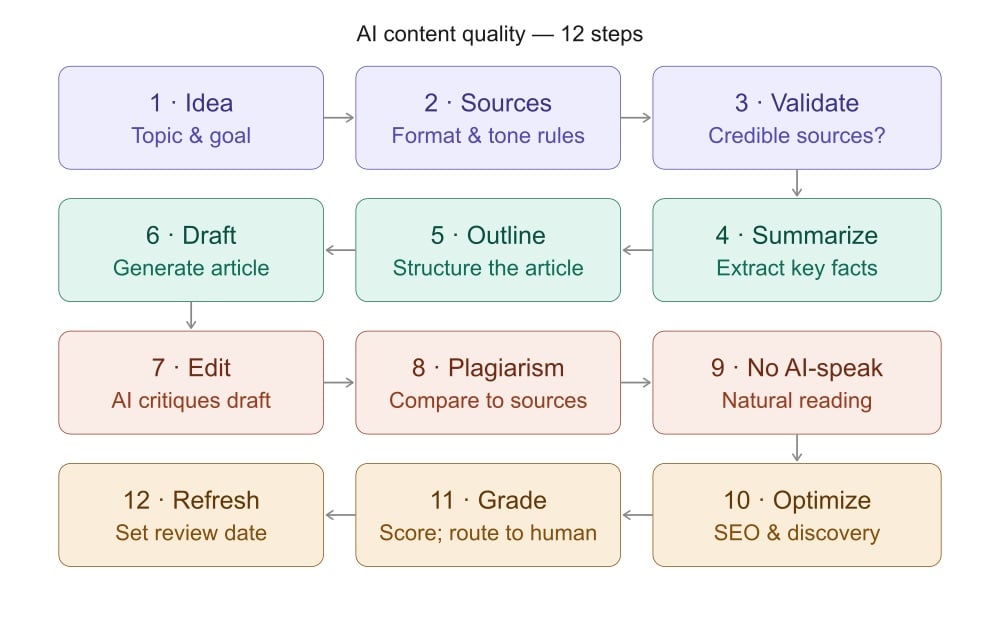
A step-by-step framework can improve the quality of AI-generated content. Click image to enlarge.
- Idea. Pick a specific topic and goal for the article.
- Sources and brief. Gather strong source material and set the rules for format, tone, and style.
- Validate. Check the inputs. Are the sources credible?
- Summarize. Pull the useful material from each source. Focus on relevant facts, data, and claims.
- Outline. Prompt the AI to provide a clear structure for how the article opens, progresses, and ends.
- Draft. Prompt the AI to generate the full article from the outline and summaries.
- Edit. Ask the AI to critique the draft against the brief, summary, and outline.
- Plagiarism. This is often overlooked. Have the AI compare the draft against sources. Consider a dedicated plagiarism checker, such as Grammarly’s API.
- No AI-speak. Ensure the output reads naturally.
- Optimize. Prompt the AI to optimize the article for search engines, answer engines, and Google Discover. Consider using the Discover click-through predictor.
- Grade. Prompt the AI to grade the article against steps 7-10. Assign the good scores to a human reviewer.
- Refresh trigger. Have the AI set a review date for updates.
AI has lowered the cost of producing content. It has not lowered the standard required to compete. In fact, the opposite is true.
The marketers who win in 2026 will generate the best content, not the most.





 AI Shopping Could Mean Fewer Returns
 New Ecommerce Tools: September 23, 2026
 Test Your Products for AI Discovery
 Shopify Opens to Meta Muse; Amazon Balks
 5 Levers Drive CAC, Says Ad Pro
 New Ecommerce Tools: September 30, 2026