


Attribution for ecommerce advertising campaigns remains messy despite long lists of AI-fueled tracking techniques and tools.
Google Ads reports the return on ad spend, or ROAS. Meta tracks purchases, conversion value, and cost per results for ads on its networks. Email platforms report revenue per send, and affiliate services track commissions and conversions.
Each of those is a niche in a larger promotional universe — a tree in a forest, so to speak.
The trees represent the details, such as the performance of a Meta Ads campaign. And the forest is the big picture, the overall revenue or growth goal.
It is certainly important to know the ROAS of individual campaigns, yet ecommerce teams must track overall marketing success. The marketing efficiency ratio can help.
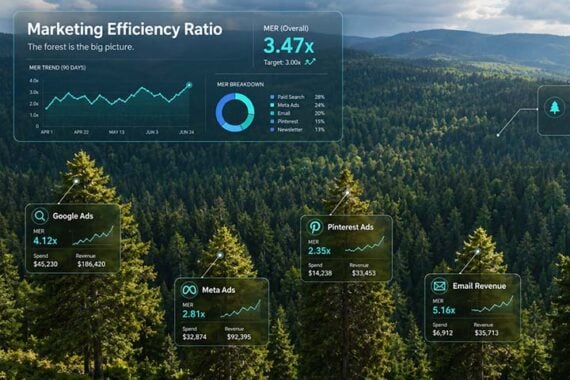
The marketing efficiency ratio can help merchants see the forest.
What Is MER?
The marketing efficiency ratio is a simple indicator that compares total revenue to total marketing spend.
It does not replace channel-specific metrics such as ROAS, CAC (customer acquisition cost), or lifetime value. But it can provide marketers with a useful view of the entire business.
The calculation is straightforward.
MER = Total Revenue ÷ Total Marketing Spend
Say an ecommerce company generated $500,000 in sales last month and spent $100,000 on marketing, including advertising, agency fees, and affiliate commissions.
The company’s MER would be 5.
$500,000 ÷ $100,000 = 5
Put another way, the company generated $5 in revenue for every $1 spent on marketing. Some marketers call this “blended ROAS” because it considers all marketing spend and all revenue, rather than a single campaign or channel.
MER vs. ROAS
ROAS and MER are related but answer different questions.
ROAS typically measures the performance of a particular campaign, channel, or tactic. A Google Shopping campaign might have a ROAS of 4.2, for example.
MER measures the entire marketing effort and assesses whether the total investment produces adequate revenue.
Hence ROAS might help a marketer decide to pause a campaign, change creative, or adjust bids. MER can help that same marketer understand whether the company’s total spend is worthwhile.
Inputs
MER is only as useful as the inputs. Ignoring some costs will inflate the ratio. An accurate metric includes everything:
- Advertising expense.
- Agency fees.
- Affiliate commissions.
- Influencer costs.
- Email and SMS software.
- Creative production.
- Marketing labor.
Consistency is key. If it includes agency fees in January, a company should include them in February and March.
Budgeting
MER is helpful because ecommerce marketing is rarely linear. A shopper may click a Meta ad on Monday, read an email on Wednesday, search for the brand on Friday, and purchase on Saturday. Each platform tells a different story about the order.
A good multi-touch attribution model can help, but MER avoids the argument altogether. It does not assign credit to a single channel or touchpoint.
This blended view can help with budgeting. If it operates profitably at a 4.0 MER, struggles at 3.0, and loses money below 2.5, the company’s marketers have useful guardrails for spending.
MER can also move the focus from clicks, impressions, and platforms to revenue and profit.

Big Picture
There is no universally accepted MER. It depends on the business.
An ecommerce shop with a 70% gross margin may tolerate a lower MER than a shop with 25%.
Conversely, a high MER might mean the company is underinvesting in growth, while a low MER could signal waste.
MER is a key metric because it is simple and easy to grasp. It complements, but does not replace, ROAS, CAC, margin analysis, and marketing mix modeling.
In short, MER provides marketers with the big picture: whether a store’s marketing spend is working or not.





 AI Shopping Could Mean Fewer Returns
 New Ecommerce Tools: September 30, 2026
 Don’t Make Them Count
 Retail Media's Opportunity Cost
 New Ecommerce Tools: October 7, 2026
 New GSC Image Filter Aids Product Discovery