


Proposed legislation introduced last week in the U.S. House of Representatives could give marketplace sellers new protections against alleged policy violations that result in frozen revenue and stranded inventory.
Ecommerce marketplaces such as Amazon and Walmart offer merchants tremendous opportunities. Even the tiniest enterprise can put its products in front of millions of potential customers.
Once sales start rolling in, however, a seller can become dependent on the marketplace channel. An alleged policy violation that disrupts revenue flow can threaten the business altogether.
Federal Bill
The “Online Sellers’ Bill of Rights Act of 2026,” introduced July 21 by Rep. Becca Balint (D-Vt.) and several co-sponsors, would require online marketplaces to explain account suspensions and related enforcement actions, respond within defined time limits, and give affected sellers a meaningful opportunity to appeal.
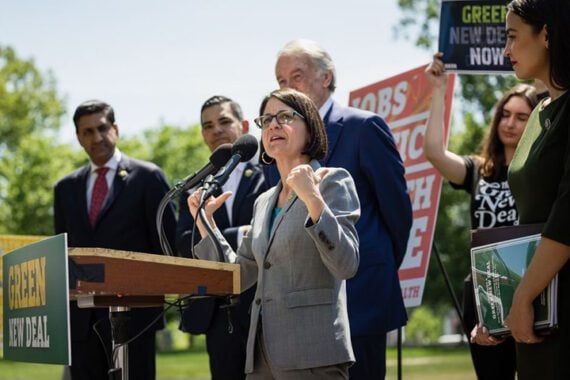
Rep. Becca Balint (D-Vt.) and several co-sponsors introduce the bill that would require something akin to due process for marketplace policy enforcement.
H.R. 9799 would not prevent marketplaces from removing counterfeit goods, suspending fraudulent sellers, or enforcing product safety policies. It would instead establish federal standards for inventory holds, frozen payments, policy changes, investigations, and appeals.
The House Judiciary Committee is now considering the proposal. Nonetheless, the hope is that legitimate sellers would benefit without letting crooks off the hook.
Provisions
The bill would create several protections for third-party sellers facing marketplace enforcement actions.
Inventory holds. Some marketplaces hold inventory in cases of alleged counterfeiting. Stranded items might be in the warehouse for months, but under H.R. 9799, holds and inventory restrictions could last no more than 30 calendar days.
After that, the marketplace would have to release the merchandise unless it could demonstrate clearly that the goods were counterfeit or otherwise unlawful.
Payment holds. H.R. 9799 would impose a similar 30-day limit on frozen seller funds.
To hold the money longer, the marketplace would have to demonstrate, by evidence, that the funds came from unlawful transactions. Suspicion alone would not be sufficient.
Gated products. The legislation also addresses products that become restricted after a marketplace has already accepted them into its fulfillment network.
If a platform imposed a new restriction on a product or category, it would have to give the seller at least 30 days to sell the remaining inventory or return the merchandise at no cost to the seller.
Notification. If passed, ecommerce marketplaces would have to provide at least 30 days’ written notice before making material changes involving product eligibility, listing restrictions, compliance requirements, commissions, or fees.
That notice could give sellers time to change packaging, obtain documentation, revise prices, or remove inventory before enforcement begins.
Seller appeals. When investigating a seller, deactivating an account, or suspending a listing, a marketplace would have to provide individualized information about the alleged violation.
For example, the platform would have to identify the policy involved, disclose the relevant facts or documents, describe the proposed penalty, and explain how the seller could appeal. It would also have to provide an anticipated timeline for resolving the matter.
Generic or templated responses would not satisfy the requirement.
Commercial Due Process
The bill appears designed to preserve enforcement of marketplace policies while adding something resembling commercial due process.
Amazon, Walmart, and other marketplaces need the authority to stop fraud, remove counterfeit goods, and protect shoppers from unsafe products. The legislation would, therefore, not give every merchant an unconditional right to remain on a platform.
It would instead change the process. Thus Amazon could still suspend a business. It would simply have to explain and support the decision.
Legal Exposure
If H.R. 9799 becomes law, the Federal Trade Commission will have 180 days after enactment to issue rules. Violations of those rules would be treated as unfair methods of competition under the Federal Trade Commission Act. State attorneys general could also bring civil actions on behalf of residents.
The bill would give injured sellers a private right to sue in federal court, even when a marketplace agreement requires arbitration.
A successful plaintiff could recover three times the damages suffered, along with court costs and reasonable attorneys’ fees.
Those remedies would give the law considerably more force than a simple notice requirement. Expect marketplace operators to challenge these provisions.

Coverage
A weakness of the bill includes uncertainty about which platforms it would cover.
It defines a “critical trading partner” as one capable of restricting a business’s access to customers or to tools or services to serve them. That language is broad enough to encompass many ecommerce marketplaces.
Yet the definition of a third-party seller is a business operating on a “dominant platform.” The legislation does not establish a revenue, transaction, user, or market-share threshold for determining dominance.
Amazon and Walmart appear to be the primary targets. Whether the law would apply equally to eBay, Etsy, Poshmark, or smaller specialized marketplaces is less certain.
The FTC could address some of that uncertainty through rulemaking, but the absence of a measurable threshold could also produce legal challenges.





 New Ecommerce Tools: September 16, 2026
 Test Your Products for AI Discovery
 Branded Sites Are Vital for Merchants
 Drive Awareness with Video Sequence Ads
 Does Retail Media Add Value?
 New Ecommerce Tools: September 23, 2026