


The E.U.’s General Product Safety Regulation applies to digital commerce, global supply chains, and internet-connected devices.
First issued in 2001, the revised GPSR became effective in December 2024 and applies to all merchants selling into the E.U., including those based in the U.S.
Unlike sector-specific rules for toys or electronics, the GPSR is a broad framework covering products and safety obligations not fully addressed elsewhere, such as home goods, sports equipment, accessories, kitchen items, and lifestyle items.
Responsible Person
The most significant requirement for non-E.U. sellers is the obligation to designate an E.U.-based “Responsible Person,” sometimes called a Responsible Economic Operator.
Under the GPSR, non-E.U. manufacturers and merchants must ensure that someone inside the European Union is formally responsible for product safety compliance, such as an importer, authorized representative, fulfillment provider, distributor, or another company.
The Responsible Person’s contact details must appear on the product, packaging, or accompanying documentation.
The requirement is an operational hurdle for foreign merchants accustomed to shipping from domestic warehouses, who may now need E.U. based representation.
Listing Requirements
Safety-related information on ecommerce listings must be visible before purchase, not only on physical packaging.
Depending on the category, product listings may require the manufacturer’s name, the Responsible Person’s contact details, batch numbers or other identifiers, intended use, safety warnings, and care instructions. The requirement applies to products on Amazon, Etsy, eBay, or a merchant’s own ecommerce site serving E.U. customers.
For example, a product page on Amazon.de could include a dedicated “Product Safety” section, such as:
E.U. Responsible Person: Acme E.U. Compliance GmbH, Berlin, Germany, gpsr@acme-eu.com
Manufacturer: Acme Home Goods LLC, Austin, Texas
Product ID: ACG-2047
Warning: Keep away from children under 3 years.
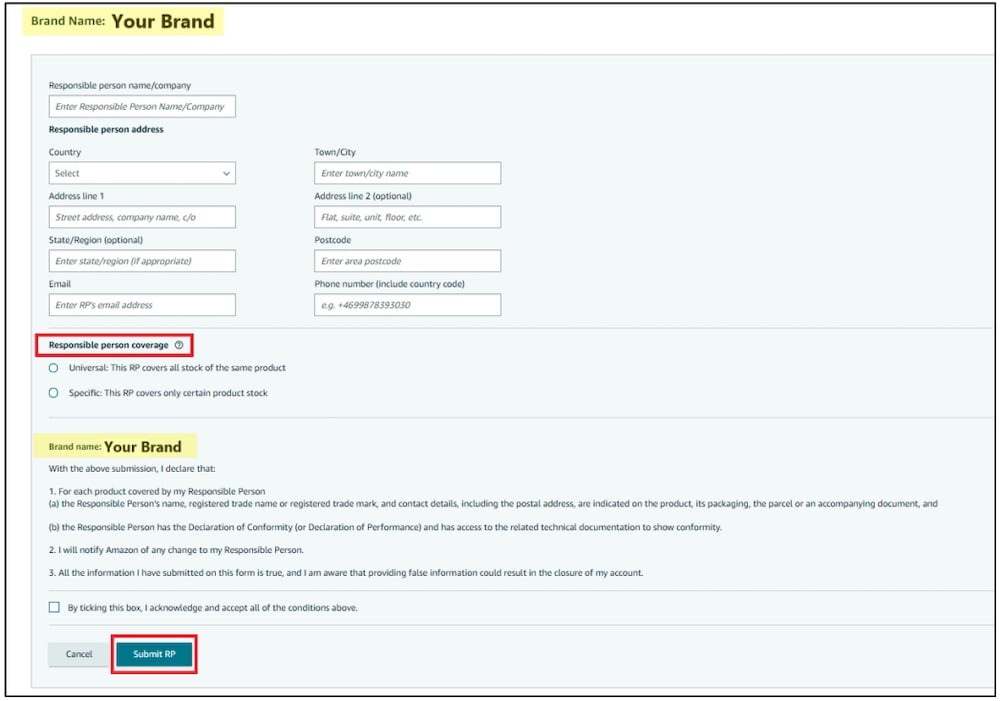
Amazon’s Responsible Person dashboard includes E.U.-based compliance contacts for eligible products. Image: Amazon Seller Central.
Marketplace Enforcement
Many merchants first encounter the GPSR through marketplaces, which must enforce its rules or face fines or sanctions. Effectively, marketplaces are now frontline compliance gatekeepers and routinely verify listings and request missing info.
In practice, merchants lacking required E.U. representation or documentation may face delistings before regulators contact them directly.
Traceability
The GPSR also strengthens traceability obligations.
Products must include identifying information that allows authorities and sellers to trace items through the supply chain and remove them quickly if safety issues emerge. Manufacturers must maintain technical files and related safety documentation for up to 10 years.
For merchants operating dozens or hundreds of SKUs, maintaining structured compliance records can become a substantial operational task.

Next Steps
Merchants selling into Europe should take three steps.
First, determine whether products fall within GPSR’s scope. Most non-food consumer goods do.
Second, appoint an E.U.-based Responsible Person and update product labels and listings with the required contact information.
Third, assemble and maintain technical documentation, including risk assessments, compliance records, and traceability information.
GPSR compliance is now a cost of doing business in Europe, similar to VAT registration or customs administration. Plan for GPSR before entering the market, not after.





 AI Shopping Could Mean Fewer Returns
 New Ecommerce Tools: September 23, 2026
 Test Your Products for AI Discovery
 Shopify Opens to Meta Muse; Amazon Balks
 5 Levers Drive CAC, Says Ad Pro
 New Ecommerce Tools: September 30, 2026