


Consumer-focused ecommerce in Africa faces the challenge of high customer acquisition costs and complex residential delivery.
Yet in Sub-Saharan Africa, approximately 90% of consumer spending remains anchored in physical retail: mom-and-pop shops, neighborhood kiosks, and market stalls.
Consequently, ecommerce is shifting toward B2B distributors that serve these retailers directly. The platforms are moving beyond delivery apps into core supply chain infrastructure, taking on inventory sourcing and trade credit.
Retail Aggregation
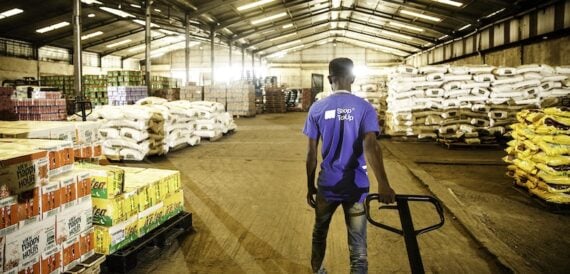
Nigeria-based TradeDepot is a prominent B2B distributor. Image: TradeDepot.
In many African cities — Lagos, Nairobi, Cairo — consumers make frequent, small-value, in-person transactions. Supplying these sellers in bulk lowers overall restock costs.
In Lagos, for instance, where gridlock can reduce a B2C courier’s daily capacity, a B2B truck delivering to a concentrated retail node can move five times the volume in a single trip.
Nigeria’s TradeDepot uses a sophisticated pre-selling model in which its fleet moves only across a specific cluster of shops. This ensures that every truck leaving the warehouse has a guaranteed high-density route.
Working Capital
Banks struggle to lend to small physical shops owing to little visibility into daily cash flow and inventory turnover. B2B distributors, by contrast, capture this data with every SKU delivered.
With this visibility, distributors can offer revolving inventory credit themselves.
For example, B2B distributors MaxAB and Wasoko (merged in 2024) collectively serve over 450,000 African merchants. In Egypt, the company’s finance arm generates over $180 million in annual turnover, outpacing its core ecommerce division. With repayment rates reportedly above 99%, the distributor becomes the acquisition channel, and working capital becomes the product.
Visibility
B2B distributors are changing how demand is understood and controlled.
Historically, fast-moving consumer goods brands sold into wholesale networks and lost granular visibility once products left the warehouse.
Distributors such as MaxAB-Wasoko provide SKU-level visibility at the point of retail. A brand manager at, say, Unilever or Nestlé can now see what is selling and where.
This real-time data enables brands to adjust pricing and allocate inventory precisely, bypassing the friction typically absorbed by intermediaries.

For Brands
- Prioritize infrastructure. Focus on distributors that own the last mile — the distance between the warehouse and the retail shelf.
- Look beyond the goods. Physical goods are primarily a vehicle for data acquisition in a 2-5% margin environment. Long-term profitability may lie in embedded finance.
- Solve for continuity. A small-shop retailer’s primary threat is the stock-out. Brands that guarantee inventory availability will win over those competing on price alone.





 Retail Media's Opportunity Cost
 New Ecommerce Tools: October 7, 2026
 New Ecommerce Tools: October 14, 2026
 New Ecommerce Tools: October 21, 2026
 Guardrails for Google Ads AI
 Desktop Habits Hide Mobile Friction