


A family-owned florist in Spain tracked ChatGPT-driven orders and found revenue blooming.
“Your 22 October column, ‘AI Shopping Metrics Considered‘, and ‘Mixed Reports on AI Ecommerce Traffic‘ from April are why I’m writing,” explained José Pérez Sánchez of Persa Flores in an email message. “Since September 2026, one in five of our online orders has come from someone who found us in ChatGPT.”
Pérez Sánchez had used his company’s own data to extend the arguments made in those earlier articles. He says AI-referred shoppers are difficult to identify without order-level attribution.
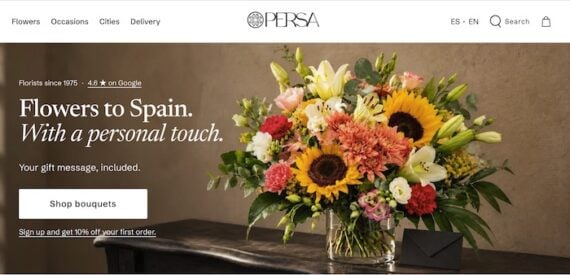
Since September, ChatGPT has driven 20% of online orders to Persa Flores, a Spain-based florist.
No Referrer
“For every order, Shopify records the customer’s first and last visit before buying: where they came from, the referring site, the landing page with its full URL, and the date,” wrote Pérez Sánchez in response to questions about how his business identified which sources lead to sales.
“We count an order as ChatGPT when either [the first or last] visit came from ChatGPT or OpenAI,” Pérez Sánchez explained. “Every one of these orders arrived on a link tagged utm_source=chatgpt.com, which ChatGPT adds itself. [But] only about one in eight also showed ChatGPT as the referrer, so a shop that checks referrers alone will miss most of this traffic.”
The missing data can be confusing, and so can the word. In technical parlance, the word “referrer” is traditionally misspelled as “referer.”
Regardless, a “referrer” is a visitor’s last URL before arriving at the target website. A web browser passes the referrer in the HTTP header, where various analytics tools read it.
Yet those tools can miss a referrer for many reasons — policies, privacy settings, or a protocol downgrade from HTTPS to HTTP — and instead label the traffic as “direct” or “unknown.”
In Persa Flores’ case, the labels had been hiding visits from ChatGPT.
Flourishing Channel
Once the Persa Flores’ marketing team could identify ChatGPT-driven orders, the channel looked increasingly important.
ChatGPT accounted for 4% of the florist’s online orders in July 2026, 12% in August, and 21% in September. Through October 27, the share had reached 23%. Similarly, ChatGPT drove 2% of online revenue in July, 11% in August, 18% in September, and 26% through October 27.
| Month | % of Orders | % of Revenue |
|---|---|---|
| July 2026 | 4% | 2% |
| August 2026 | 12% | 11% |
| September 2026 | 21% | 18% |
| October 2026 (to the 27th) | 23% | 26% |
| September-October 2026 | 22% | 22% |
| July-October 2026 | 16% | 15% |
Pérez Sánchez did not share the company’s raw order counts, but he noted that total online orders also grew during the period. ChatGPT therefore gained share while the overall ecommerce business was expanding.
He published the findings on the company’s site late last month.
Most of that growth also preceded any deliberate effort to improve Persa Flores’ visibility in ChatGPT. Pérez Sánchez explained that the company did not implement optimization tactics for the chatbot until mid-October, after the increase.
Follow the Order
Identifying ChatGPT as a source was the first step. Next, he examined what those shoppers actually did.
Every ChatGPT-attributed order came from a first-time customer. Shopify showed no previous order from the shopper’s email address or account, wrote Pérez Sánchez.
Most of those customers placed an order within a day of their first recorded visit. About half paid from outside Spain, typically to send flowers to someone in the country.
Average order value was about the same as other online orders, though Pérez Sánchez noted that the company does not track conversion rate by source precisely enough to compare ChatGPT with Google or other channels.
The order data therefore offered something traffic reports alone could not: ChatGPT was bringing in new customers and, in turn, new paths to purchase.
City Pages
“84% of ChatGPT customers first arrived on a city page, compared with about a third of customers from Google,” wrote Pérez Sánchez.
Each Persa Flores city page focuses on sending flowers to a city in Spain, such as Marbella, Madrid, Alicante, A Coruña, Gijón, and Segovia.
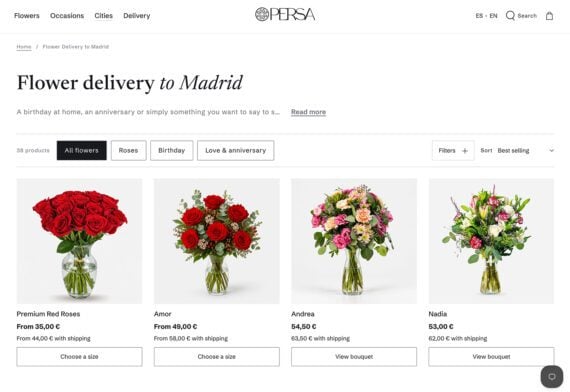
Persa Flores’ city pages are not a new tactic, but they are paying off in a new channel.
The pages, available in Spanish and English, explain who Persa Flores is and show available bouquets with delivery prices.
“When someone asks ChatGPT how to send flowers to a particular town, a page dedicated to exactly that is an easy answer to give,” wrote Pérez Sánchez.
This is not a new tactic. Search optimizers have long created location- or intent-specific landing pages to match a search query more closely than a category or home page.
What is different here is the intermediary. ChatGPT appears to match a shopper’s question to a page with the answer.
Persa Flores did not build the city pages for ChatGPT. They were in place before the channel’s growth, suggesting that familiar SEO practices may boost AI-driven shopping.
AI Attribution
For Persa Flores, ChatGPT traffic was easy to miss. Identifying AI-driven product discovery and sales may require merchants to follow customers beyond standard traffic reports.





 New Ecommerce Tools: October 21, 2026
 New Ecommerce Tools: October 14, 2026
 Beware of AI Content for SEO
 Shopify, Vercel Arm Stores for AI Agents
 AI Platforms Attract a Growing Ecosystem
 Commerce Data as Credit Data

