


Amazon announced this week a new artificial intelligence feature in Seller Central that helps merchants explore performance data through visual workspaces rather than static reports.
Described as “a dynamic canvas experience,” the feature hints at a broader shift in reporting software toward what might be called conversational business intelligence.
Canvas Experience
To use this canvas experience, a seller could ask the Amazon AI assistant how advertising campaigns affected product sales, or request a sales comparison between two periods, as examples.
The AI assistant will then generate charts and graphs that display the requested metrics. The system becomes a text- or chat-based interface for Amazon’s vast marketplace datasets.
Sellers can arrange these visual elements within a custom workspace. Amazon describes the tool as a way to experiment with data rather than merely view reports.
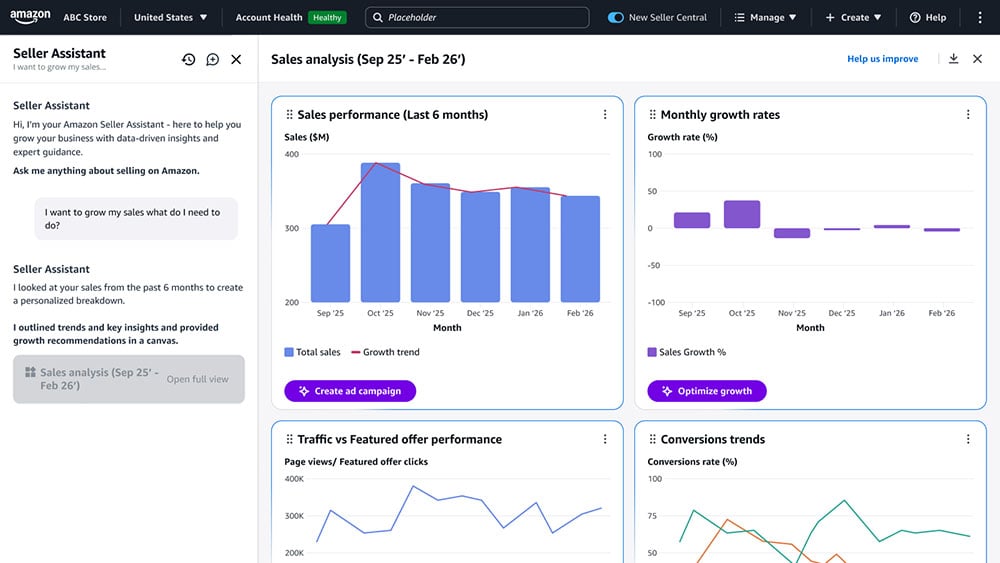
Amazon’s AI-driven “canvas experience” suggests a larger trend toward conversational business intelligence tools. Click image to enlarge.
Workspace Trend
Given the rapid improvements and applications of AI, the Seller Central canvas experience is part of a broader trend in business analysis software.
It suggests a future in which folks rely less on spreadsheets, manual reporting, and even business intelligence tools, and more on AI systems that interpret signals, inform, and make decisions.
Performance analysis changes from someone digging through data or building reports to a conversation.
Tools such as the Seller Central AI canvas suggest future ecommerce analytics may look less like traditional dashboards and more like an ongoing dialogue. The seller asks questions. The system surfaces insights. Decisions follow.
There’s evidence of this trend beyond Amazon.
For example, Shopify’s Winter ’26 platform update introduced more than 150 AI-related enhancements, including updates to Sidekick, its AI assistant. The improved tool, including Sidekick Pulse, helps merchants analyze data, generate tasks, and automate workflows. Merchants can query Sidekick about sales trends, inventory, or marketing performance, much like the Amazon assistant.
Conversational BI
That concept — asking AI about business data — is not necessarily new. Variations of conversational business intelligence are already appearing in analytics software.
Tools such as Power BI, Looker, and Qlik allow users to ask questions in natural language — “Why did our conversion rate drop yesterday?” — and receive charts and summaries.
Implications for Merchants
Online sellers already have access to more data than they can realistically analyze. Amazon Seller Central alone provides reports covering traffic, conversions, advertising performance, and inventory levels. Understanding how those metrics interact often requires exporting data, building spreadsheets, or using external analytics tools.
Conversational business intelligence could reduce that complexity.
Instead of searching reports, a merchant might ask questions about performance and receive charts, summaries, and explanations within seconds. As they mature, the tools could change how merchants interact with ecommerce data in several ways.
- Lowering the analytics barrier. Businesses gain access to insights that once required advanced reporting tools or technical expertise.
- Faster decision-making. Merchants could receive performance data in near real-time.
- More experimentation. AI-driven workspaces facilitate broader testing and analysis.
- Better visibility across systems. Over time, the tools could connect disparate sources of ecommerce data, such as advertising platforms, analytics services, and marketplaces.
Still, conversational business analysis is unlikely to replace traditional reporting entirely. Merchants will still need reliable data models, clear metrics, and an understanding of how their businesses operate.

Decision Makers
As AI technology improves, the systems may move beyond answering queries to proactively recommend actions or even execute them automatically.
Within parameters, an AI assistant might increase the spend for a profitable advertising campaign, pause a poorly performing keyword group, or alert a merchant that inventory is running low — all on its own.
Thus conversational business intelligence may foretell a more automated environment wherein software not only explains the data but also helps run the business.
For now, tools such as Amazon’s Seller Central canvas may only respond to questions. But as AI evolves inside ecommerce platforms, the distance between insight and action should quickly shrink.





 AI Shopping Could Mean Fewer Returns
 Shopify Opens to Meta Muse; Amazon Balks
 New Ecommerce Tools: September 30, 2026
 Don’t Make Them Count
 New Ecommerce Tools: October 7, 2026
 Retail Media's Opportunity Cost