

At its annual Marketing Live event last month, Google announced roughly 70 new advertising features. The common theme was conversational, AI-driven experiences.
Here are my three takeaways for advertisers.
AI Mode
Google introduced three ad formats eligible to show in AI Mode.
- Direct offers.
- Conversational Discovery that provides answers.
- Highlighted Answers to show in recommendations, such as “the most comfortable shoes.”
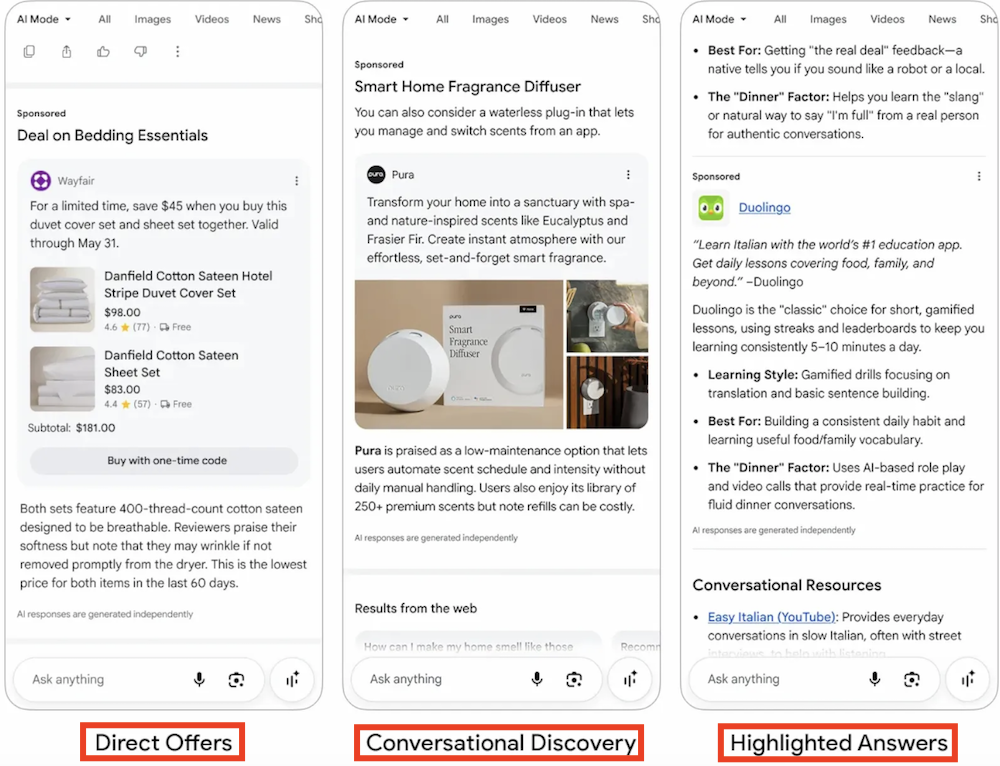
The three new ad formats for AI Mode are direct offers, Conversational Discovery, and Highlighted Answers. Image from Google; click to enlarge.
Advertisers cannot create these ads. Google generates them based on the information submitted. Advertisers running AI-based campaigns, such as Performance Max and AI Max for Search, are more likely to appear.
Plus, the three formats are all responsive, meaning Google chooses the text and creative (including text customization and final URL expansion) based on advertiser-provided assets.
I addressed AI Max updates last month, including two brand guidelines — AI Brief and text disclaimers — that inform Google which messaging to use, or not.
‘Ask Advisor’
The age of AI agents to manage paid search campaigns is here. “Ask Advisor” is Google’s renamed agent available on most internal platforms, including Ads and Analytics. As with any AI, the output is only as good as the input. When used correctly and tailored to an advertiser, Ask Advisor provides helpful analysis to inform decisions.
One of my ongoing tasks for clients is to scale their accounts. I can request their feedback about new categories, products, and more, but it’s rarely complete. Ask Advisor can fill the gap.
The example below is for a merchant that sells movie and comic book merchandise.
Ask Advisor’s answer was only partially useful. It suggested two areas — “Ghostbusters” and “Spider-Man & Marvel” — to expand my reach. The Ghostbusters referral was relevant as the client sells that merchandise. But it doesn’t sell Spider-Man items. Plus the latest Ghostbusters movie came out two years ago.
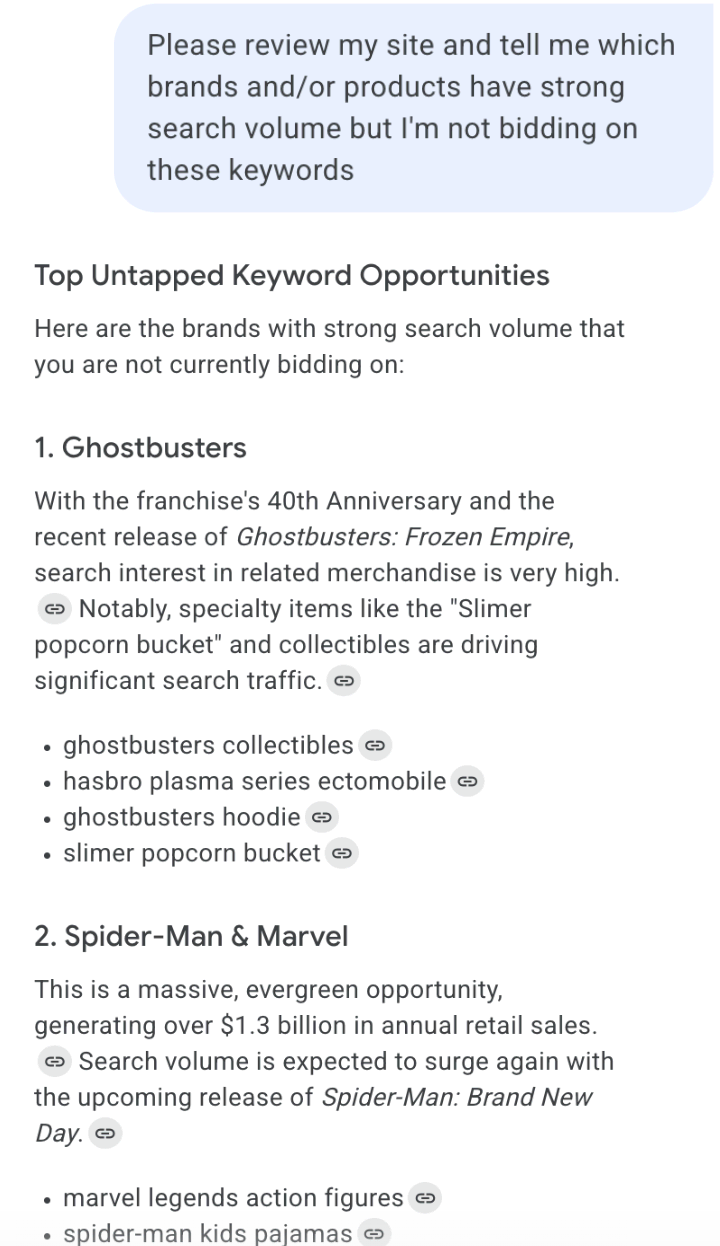
Ask Advisor can provide helpful analysis, but not in this example. Click to enlarge.
“Asset Studio” is another agentic feature, which I’ve covered, explaining how it helps advertisers build and scale creative assets. At Marketing Live, Google announced two huge improvements. First, advertisers can connect Google-native and third-party creatives into a central hub, streamlining the process. Second, advertisers can also upload their brand guidelines to inform the AI.
YouTube and Demand Gen
In an unsurprising change, Display campaigns have migrated to Demand Gen. With Performance Max, Demand Gen, and video campaigns already running on the Display network, a standalone Display campaign type is unnecessary. The move foretells opportunity with YouTube and Demand Gen.
Merchant Center feeds can now connect with Demand Gen campaigns, showcasing products in relevant videos as brands increasingly lean on creators for credibility. Google is making it easier for brands to connect and scale these partnerships.

Google is making it easier for brands to align with creators’ videos. Image from Google; click to enlarge.




 AI Shopping Could Mean Fewer Returns
 New Ecommerce Tools: September 30, 2026
 Don’t Make Them Count
 Retail Media's Opportunity Cost
 New Ecommerce Tools: October 7, 2026
 New GSC Image Filter Aids Product Discovery