


Google announced a comprehensive shopping cart that could soon be available across the search giant’s app ecosystem. The forthcoming Universal Cart may change how shoppers think about checking out.
Merchants and consumers generally expect a direct relationship between a cart and an ecommerce site.
Amazon’s shopping cart might be an exception. Like all marketplace shopping carts, it can hold products from any number of third-party sellers, but it remains a single cart associated with a single ecommerce site.
Google’s announcements on May 19 suggest that this one-to-one association may not continue.
Google I/O
Specifically, Google introduced three commerce-related features during I/O, its premiere developer conference.
- Universal Cart is persistent and AI-powered, following shoppers across Google properties and tracking products, offers, and prices, ultimately completing transactions.
- Universal Commerce Protocol is expanding checkout across markets and channels while extending into categories beyond retail.
- Agent Payments Protocol. Google’s payment layer lets AI agents complete purchases on a shopper’s behalf, subject to user-defined rules and limits.
Combined, the features constitute agentic commerce components, wherein products from disparate merchants reside in an agent-managed layer above or outside sellers’ own sites.
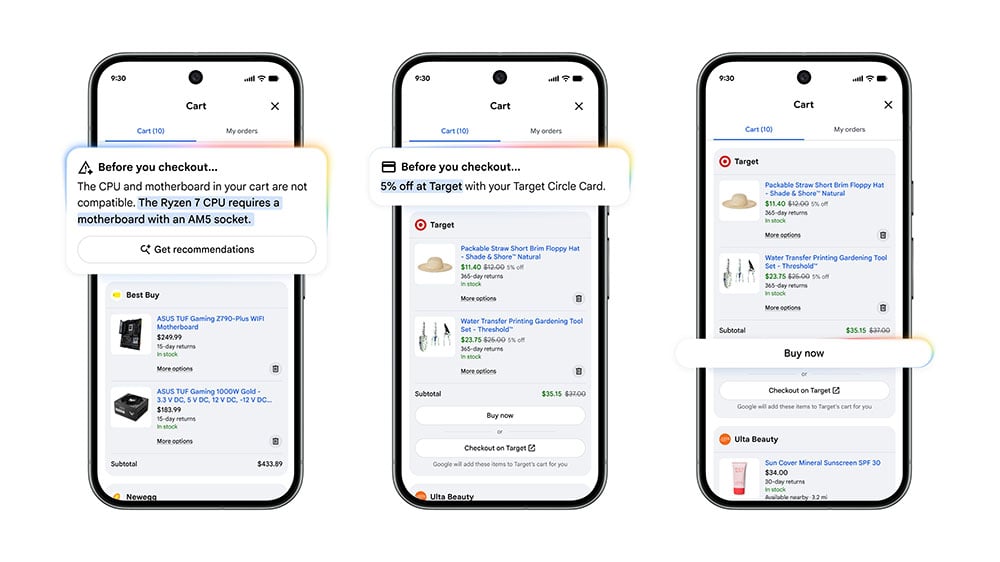
Google said it would release Universal Cart in the U.S. in the summer of 2026. Click image to enlarge.
Cart Use
In Google’s model, merchants still own the transaction, but not the purchase intent or product discovery.
To be certain, there are apparent advantages. Having Google remind shoppers about items in a cart might improve conversions. Yet it could also change how shoppers interact with merchants.
Some folks treat carts like wishlists. A shopper will add an item or two, leave, and return later. Or, perhaps, he will share the cart with a spouse before making a purchase. Others will save products while comparing alternatives, or leave items in the cart until payday. In each case, shoppers return directly to the store to consummate transactions.
Retailers understand this behavior and have spent years trying to support and capitalize on it.
If shoppers treat agent-managed carts like those of retailers, purchase intent could shift. Retailers would still fulfill orders and collect payment, but not originate the transaction.
In some ways, this has always been the promise of agentic commerce. Shopping shifts from websites to systems. Google’s announcements make that possibility feel considerably closer.
Universal Cart
With Google’s Universal Cart, shoppers can add products while searching, chatting with Gemini, and, eventually, while using YouTube or Gmail.
Once a shopper adds a product, the cart stays active, using AI to monitor prices, offers, and inventory, thus guiding the buying decision.
Merchants remain the merchant of record, even if the cart exposes shoppers to competing products or offers.
For example, imagine a shopper outfitting her newly remodeled kitchen. She adds a KitchenAid mixer after searching Google. Later, while watching YouTube videos, she saves a Le Creuset Dutch oven from another retailer and a Japanese santoku knife from an affiliate email.
The cart is still working that evening, even while she watches movies. It may suggest an alternative knife set with better reviews and faster delivery.
When she’s ready to buy, the shopper finds that Universal Cart has remembered, compared, recommended, and coordinated her order.
Recommended

A Preview of Agentic Marketplaces
May 17, 2026
Infrastructure
While Universal Cart is the visible part of Google’s agentic shopping strategy, Universal Commerce Protocol (UCP) is evidently the underlying infrastructure.
A store’s Merchant Center feeds provide product info to Google. UCP tells Google how to interact with the merchant to support shopping, checkout, and fulfillment.
Agents Payments Protocol (AP2) will appear in Google products “in the coming months,” starting with Gemini Spark, a new persistent AI agent.
In practice, Spark appears poised to automate and monitor shopping tasks for shoppers, while Universal Cart stores and coordinates shopping activities.
Spark maintains a shopper’s Universal Cart by comparing products, prices, and inventory.
Then, once the shopper establishes rules such as a spending limit, preferred retailers, or explicit approval, AP2 authorizes and completes the purchase.
Thus Universal Cart remembers, UCP connects, Spark decides, and AP2 pays.
New Experience
Agentic commerce is still in its infancy, but growing. Google’s I/O announcements foretell a different shopping cart and a new path for merchants to earn sales.



 The Race to Own AI Shopping
 New Ecommerce Tools: September 8, 2026
 Influencers Mostly Skip Disclosure
 New Ecommerce Tools: September 2, 2026
 Branded Sites Are Vital for Merchants
 New Ecommerce Tools: September 16, 2026