


Open-source ecommerce platforms are flexible and customizable with active support communities, developers, and how-to resources.
Here is our updated list — first published a decade ago — of open-source ecommerce platforms. Many have advanced features, customizable themes, and extensions. Some offer hosted enterprise versions.
Open Source Ecommerce Platforms
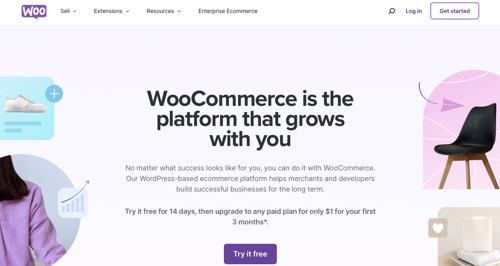
WooCommerce is an open-source ecommerce platform built on WordPress. Sell physical products, customizable bundles, appointments, and members-only content. WooCommerce offers automated tax calculations, live shipping rates from leading carriers, options to print labels, mobile apps for iOS and Android, and more. Available in 38 countries and accepting payments in 135-plus currencies, WooCommerce is highly customizable with 800 extensions. Over 3.9 million stores are built with WooCommerce.
WooCommerce
Drupal Commerce is an open-source ecommerce framework built upon the Drupal content management platform. Use Drupal Commerce to create a headless commerce backend with a frontend of choice, a full site or embedded in an existing web property. Drupal Commerce’s core systems offer product admin, shopping cart, and checkout forms with multilingual and multi-currency support. Additional features and add-ons are available via contributed modules, including roughly 100 integrations in the free module library.
Magento Open Source (formerly Magento Community Edition) is a free version of Adobe Commerce, a hosted enterprise platform. Access the Adobe Commerce Marketplace to configure Magento Open Source, with nearly 4,000 extensions and a wide range of themes, support options, and additional resources. Adobe also offers ecommerce training courses and a certification program.
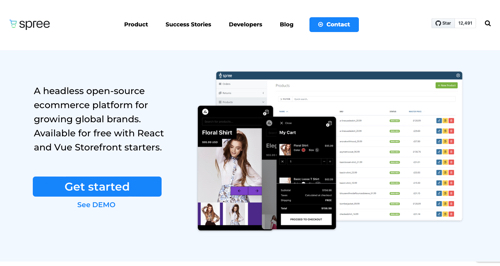
Spree is an open-source ecommerce platform, built with Ruby on Rails, for multi-language and multi-currency global brands. Spree includes pre-built React and Vue Storefront starters. Leverage over 200 third-party integrations for automation, referral, email, A/B testing, live chat, advanced analytics, CRM, helpdesk, and data warehousing. Accept one-time or recurring payments with credit and debit cards, wallets (i.e., Apple Pay, Google Pay), bank accounts, and buy-now, pay-later. Spree has more than 850 contributors, 4,800 forks, and 1.5 million downloads.
Spree
PrestaShop powers more than 300,000 ecommerce sites worldwide. Based on the Symfony framework, PrestaShop includes more than 300 features to manage a product catalog, payments, shipping, multi-shops, and more. The PrestaShop Marketplace contains thousands of modules and themes to customize a store, increase traffic, improve conversion rates, and build customer loyalty.
OpenCart runs multiple and standalone stores from one mobile-friendly interface, complete with detailed product, order, and customer management, as well as sales reports, marketing tools, and more. Set advanced user privileges and access. OpenCart offers over 13,000 modules and themes. Its forums have more than 110,000 registered members and 550,000 posts.
Joomla is a free and open-source CMS for ecommerce, reservations, small business websites, online publications, and more. Its core framework facilitates integrated commerce, inventory control systems, data reporting tools, custom product catalogs, reservation tools, and more. Joomla’s marketplace contains nearly 6,000 extensions.
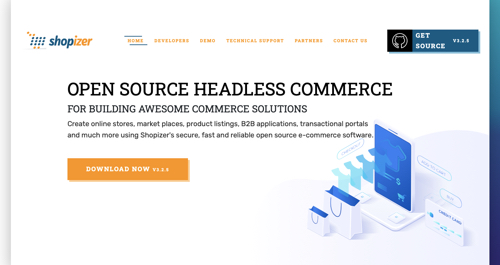
Shopizer is enterprise open-source ecommerce software for retailers to use out of the box or as a backend application for serving commerce REST APIs for a tailored frontend. Shopizer features catalog and product management, shopping cart, inventory management, promotion management, content management, smart pricing, ordering, payment, and shipping.
Shopizer
nopCommerce is an open-source platform built on Microsoft’s ASP.NET ecommerce framework. In addition to ecommerce features for small and medium businesses, nopCommerce has built-in enterprise tools such as multi-store and multi-vendor functions, advanced search engine optimization settings, marketing tools for affiliate and client loyalty programs, one-page checkout, extended product attributes, and more. nopCommerce has more than 250,000 community members.
OroCommerce is an open-source B2B ecommerce platform. The Community Edition features a multichannel customer portal, multiple shopping lists, a dynamic pricing engine, inventory management, a customer relationship tool, marketing features, and more.
Mailchimp Open Commerce (formerly Reaction Commerce) is an API-first, modular commerce stack built with Node.js, React, and GraphQL around a catalog of products. Set up products in the admin and organize them with tags to help shoppers navigate the catalog. A wide range of plugins covers basic features, including backend services, shop configuration, and the shopper experience.
Ecwid (“ECommerce WIDget”) is an ecommerce platform founded in 2009 to enable small businesses to add stores to their existing sites. Use a free customizable Ecwid Instant site with a built-in online store or integrate Ecwid with any existing website. Add your store to multiple sites, blogs, and social networks, and manage it all from one place. Premium plans let you sell on Facebook, Instagram, and Amazon.

Ecwid
Zen Cart is a free, open-source app that branched from osCommerce in 2003. Zen Cart is PHP-based, with a MySQL database and HTML components. It has over 2,000 add-ons in 16 categories. Zen Cart provides the pieces to sell online, with basic functionality for CRM, accounting, and content management.
Vue Storefront is an ecosystem of open-source tools as a frontend-as-a-service for composable commerce. Vue Storefront is compatible with any backend that has an API. It integrates with PrestaShop, Spree, Sylius, BigCommerce, Commercetools, SAP Commerce Cloud, and more. Merchants can build an ecommerce application from scratch or with the pre-installed Storefront UI components library.
osCommerce is an open-source ecommerce platform launched in 2000, compatible with any web server using PHP and MySQL installed. The Online Merchant edition is a complete store system with both a frontend and an administration backend that can be easily configured and customized using 9,100 free add-ons. More than 40,000 live sites use osCommerce. Its community has 300,000 members, and its forum contains 1.7 million posts.
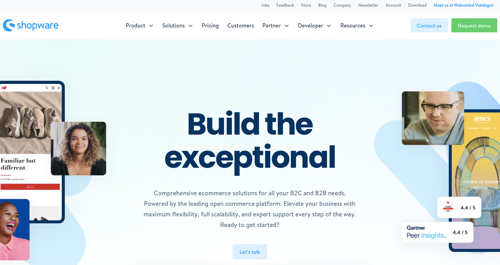
Shopware is an open-source commerce platform based on Vue and the Symfony framework and supported by 7,000 developers and 3,000 extensions. Shopware can be tailored to meet the requirements of any business model — B2B, B2C, or D2C. Create product catalogs tailored to target groups. Operate a variety of storefronts, warehouses, and inventories in one environment. Configure product prices based on customer groups or marketing strategy. Use AI Copilot to generate content and set up stores quickly.
Shopware
Sylius is an open-source, headless ecommerce platform for mid-market and enterprise brands. Released in 2016, Sylius features a flexible framework for cross-border commerce, multiple currencies, easy customization and integration, out-of-the-box promotions, an adaptable administration panel, and scalable infrastructure. Sylius is supported by more than 650 contributors and offers approximately 150 plugins. A commercial edition, Sylius Plus, is also available.
Saleor is a headless, open-source ecosystem for building rich ecommerce experiences. Its centerpiece is the Saleor GraphQL API, which processes complex online store logic around a collection of integrated services. Sell simple and configurable products with multiple variants. Handle digital and physical inventory. Saleor’s dashboard is available in 30-plus languages.

Solidus is open-source ecommerce software built on the Ruby on Rails framework as a fork of Spree. Start from a strong foundation and functional backend, then customize the required aspects through built-in configuration hooks and extensions or through Ruby’s and Rails’ native overrides. Solidus is used by stores such as Floyd, Maisonette, MeUndies, Away, Casper, Bonobos, and Ace & Tate.
Sharetribe is a headless application to build B2C and B2B marketplaces for rentals, services, products, and more. Create a marketplace in no-code with the Sharetribe Web Template. Store any type of structured data on your users, listings, and transactions. Assign multiple types of users of any product or service, and make it easy for the users to search and filter based on your custom data schema.
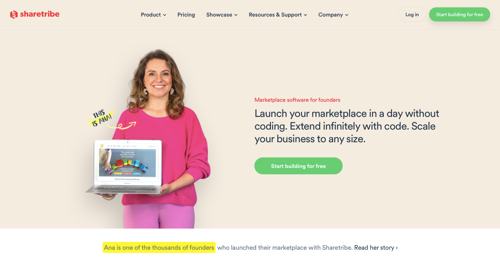
Sharetribe





 AI Shopping Could Mean Fewer Returns
 New Ecommerce Tools: September 30, 2026
 Retail Media's Opportunity Cost
 New Ecommerce Tools: October 7, 2026
 Guardrails for Google Ads AI
 New Ecommerce Tools: October 14, 2026