


Foreign brands rarely rely on a single channel when selling into Africa. They layer marketplaces, retail partnerships, and direct selling, all coupled with local logistics providers.
Marketplace-led entry
Brands prioritizing faster market access and infrastructure typically prefer marketplaces, such as Jumia and Konga, each headquartered in Lagos, Nigeria.
Both offer a third-party marketplace with a minor first-party retail component. Global brands selling on Jumia include Adidas, Samsung, Garnier, and Maybelline. Brands on Konga include Samsung, LG, Xiaomi, CeraVe, and La Roche-Posay.
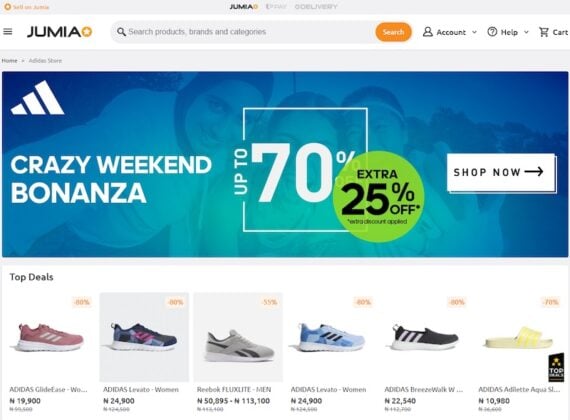
Jumia hosts major international brands, such as Adidas, shown here.
Direct selling
Merchants seeking control over pricing, fulfillment, and customer relationships move beyond marketplaces.
Top direct-sales categories include beauty, wellness, supplements, and fashion. Several brands, such as U.S.-based Fenty Beauty, ship direct to customers in Nigeria, Kenya, and South Africa, with local currencies, duties, and country-specific ecommerce storefronts.
California-based iHerb, selling vitamins and supplements, provides dedicated storefronts for Nigeria, Kenya, and South Africa and partners with DHL Express and FedEx for delivery. In South Africa, iHerb also offers delivery-duty-paid shipping, collecting duties and import fees at checkout.
The operational burden of direct selling is higher, but so is the upside. Merchants gain much more control over the brand experience instead of relying entirely on marketplace infrastructure.
Local distributors
Delivery and distribution infrastructure across Africa remains fragmented, except in large cities such as Johannesburg and Lagos.
Merchants seeking wide distribution without managing local warehouses, fulfillment, and inventory usually partner with local carriers and wholesale suppliers.
That is especially important in markets where offline commerce still dominates. Building those networks is expensive and slow. Working with existing distribution infrastructure removes most of the burden.
Fenty Beauty products, for example, are available in physical stores across Botswana, Ghana, Kenya, Namibia, Nigeria, South Africa, Zambia, and Zimbabwe.
Wasoko, a B2B distributor based in Nairobi, Kenya, supplies inventory to retailers and informal commerce networks across Africa, giving domestic and foreign brands access to retail channels beyond direct-to-consumer ecommerce.
Overlapping channels
In most cases, sales channels in Africa overlap.
Brands frequently offer direct international shipping through their own ecommerce storefront while also selling via marketplaces, retailers, and B2B distributors — all in the same market.
Fenty Beauty does this with direct international shipping to Nigeria, Kenya, and South Africa, while also maintaining local retail sites in several African countries and a marketplace presence on Konga.
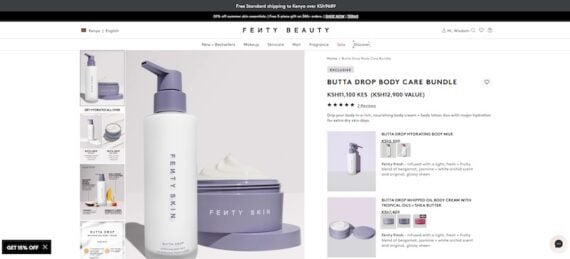
Fenty Beauty combines direct international selling with local sites across multiple African markets, including Kenya.
U.S.-based ColourPop Cosmetics sells internationally into Africa from its ecommerce storefront, while also relying on local B2B distributors for physical retail.
In short, African marketplaces are the easiest entry point owing to limited carrier and distribution options across much of the continent.
But marketplaces alone rarely drive long-term growth. Direct international selling and local retail partnerships become viable once demand is predictable. Both enable control over pricing, fulfillment, and customer relationships, and become viable once demand is predictable.



 The Race to Own AI Shopping
 New Ecommerce Tools: September 8, 2026
 Influencers Mostly Skip Disclosure
 New Ecommerce Tools: September 2, 2026
 Branded Sites Are Vital for Merchants
 New Ecommerce Tools: September 16, 2026